If I have seen further, it is by standing on the shoulders of giants.
Physics isn't just formulas. It's the language the universe speaks. We made it visible.
Six branches of physics.
Start with what exists. The rest is on the way.
CLASSICAL MECHANICS
The physics of cannonballs, planets, and pendulums.
ELECTROMAGNETISM
Light, charge, and the field that holds the world together.
RELATIVITY
The weirdness that hides at the edges of speed.
THERMODYNAMICS
Heat, entropy, and why time moves forward.
QUANTUM MECHANICS
The rules the universe actually runs on.
MODERN PHYSICS
From the nucleus to the Standard Model and beyond.
Play, ask, talk physics.
Two ways in. Ask physics anything in plain language, or drop into a playground and tune the parameters yourself — both grounded in the same hand-written physics on this site.
Talk to physics.
From Newton's apple to Schrödinger's cat — plain language, live math, every answer cited from the topics on this site.
Math, rendered. Sims, embedded.
Equations come out live, not as screenshots. When words aren't enough, Physics.Ask drops a live simulation right into the answer.
Drop a body, set it loose.
Click to add a mass, drag to give it velocity, then watch n-body gravity figure the rest out. Real symplectic Verlet — energy is conserved.
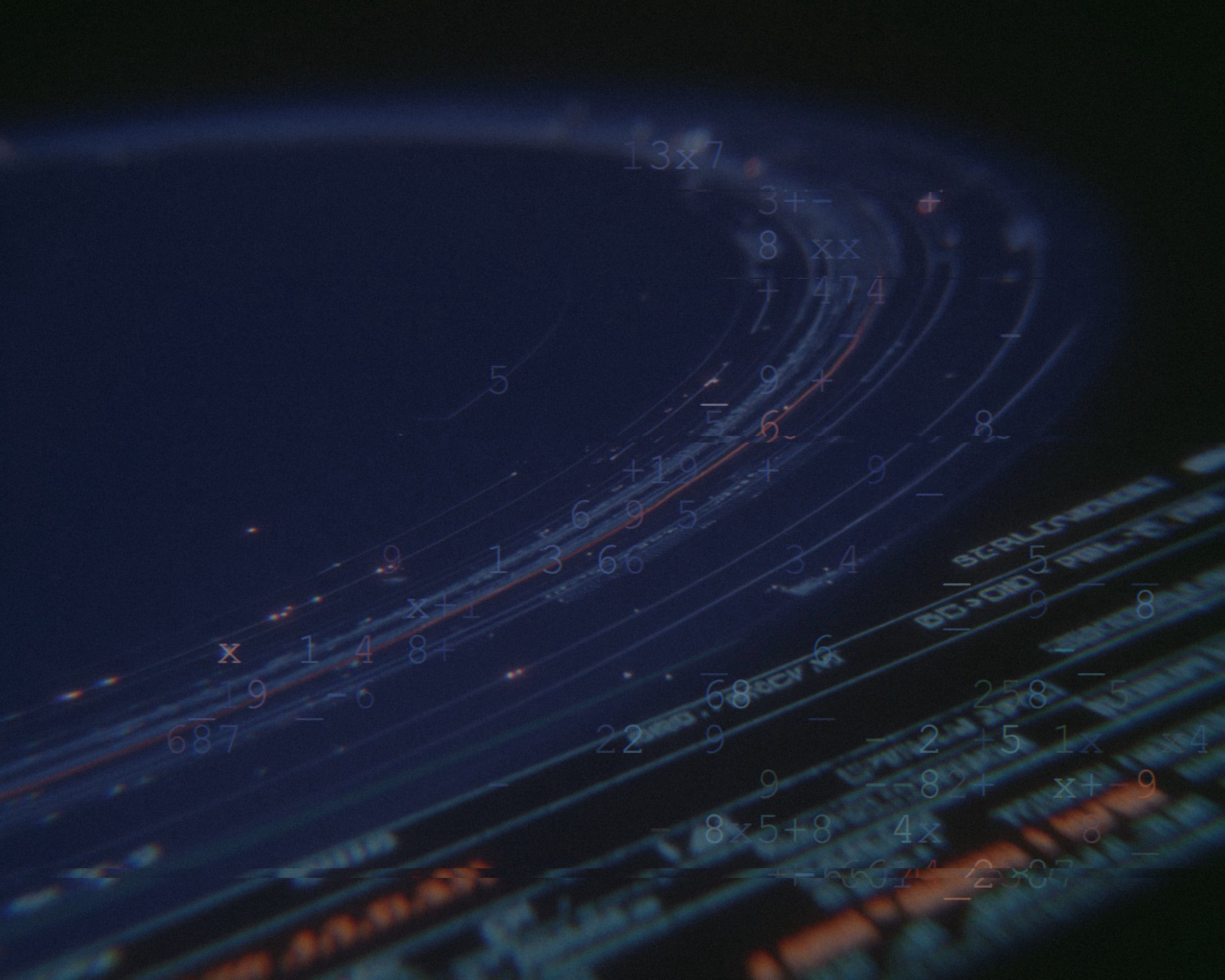
Past, present, prediction.
Faded trails behind, predicted ellipses ahead. Figure-8 choreographies, mini solar systems, Burrau's chaos — and every state lives in the URL.
The people behind the laws.
Galileo timed a chandelier against his pulse. Kepler ground eight years into the motion of Mars. The site's cast, in brief.
Göttingen mathematician who helped shape general relativity and championed Noether through institutional prejudice.
Inventor and industrialist who turned the laboratory gyroscope into the central navigation instrument of twentieth-century ships and aircraft.
Galileo's last student — invented the barometer, discovered atmospheric pressure, and wrote the first projectile tables.
The Basel mathematician who insisted, against Euler's objections, that every vibration is a sum of sinusoids.
Measured the first galactic redshifts in 1912, a decade before Hubble's expansion law.
The Soviet polymath who axiomatised probability and wrote the one law of turbulence we know.
Danish physicist who founded electromagnetism by accident in an 1820 lecture demonstration when a current-carrying wire deflected a compass needle.
French physician and physicist whose acoustical instruments became laboratory standards, and who collaborated with Biot on the magnetic-field-from-current-element law in 1820.
Start here: The Pendulum.
The pendulum is the first serious toy physics ever gave us. It was how Galileo discovered that time could be measured by motion, and how three hundred years of clocks kept pace with the turning of the Earth.
Its motion looks simple — a bob swinging back and forth — but hiding inside that swing is the most important equation in all of oscillations. Pull it out, and you get music, lasers, bridges, and the guts of quantum mechanics.
The shared vocabulary.
Instruments, concepts, phenomena, and units — the words that keep coming back across every chapter.
The total energy of an isolated system — mechanical, thermal, chemical, radiated — is constant over time.
A collision in which total kinetic energy is conserved as well as total momentum.
Mechanical clock regulated by a swinging pendulum; first accurate timekeeper, built by Huygens in 1656.
Optical instrument that gathers light and magnifies distant objects; from Newton's 1668 reflector to the James Webb Space Telescope.
Pre-telescope astronomical instrument for measuring the angular position of stars and planets.
Ancient inclinometer and analog computer for astronomical calculations, used for position, time, and star identification.
Property of oscillating with a constant period regardless of amplitude; Galileo's 1583 discovery.
Small circle whose center moves along a larger one; Ptolemy's device for saving uniform circular motion.
Three rules for every topic.
Real math, not cartoons.
Every animation is driven by a unit-tested physics solver — odex for ODEs, Newton-Raphson for Kepler's equation, analytic solutions where they exist. If a number appears on screen, it's correct to at least three decimals.
Support what we build.
Physics.explained is free and has no ads. It's supported by the other products our small team builds — if they're useful to you, that's what keeps this site running.

