telescope
Optical instrument that gathers light and magnifies distant objects; from Newton's 1668 reflector to the James Webb Space Telescope.
Definition
A telescope is a light bucket. Its job is not really to magnify — magnification is cheap, you can stack eyepieces — but to collect photons and bring them to a sharp focus. Two numbers describe almost everything. The first is aperture, the diameter D of the primary lens or mirror. Light-gathering power scales with the area of the aperture, D². Resolving power — the smallest angle the instrument can distinguish — is set by diffraction: the Rayleigh limit gives θ ≈ 1.22 λ/D. Bigger aperture means more light and finer detail. The second is focal length, which together with the eyepiece sets the magnification. A large aperture with modest magnification reveals faint structure; a small aperture cranked to high power just shows you a bigger blur.
Newton's reflector — the canonical example
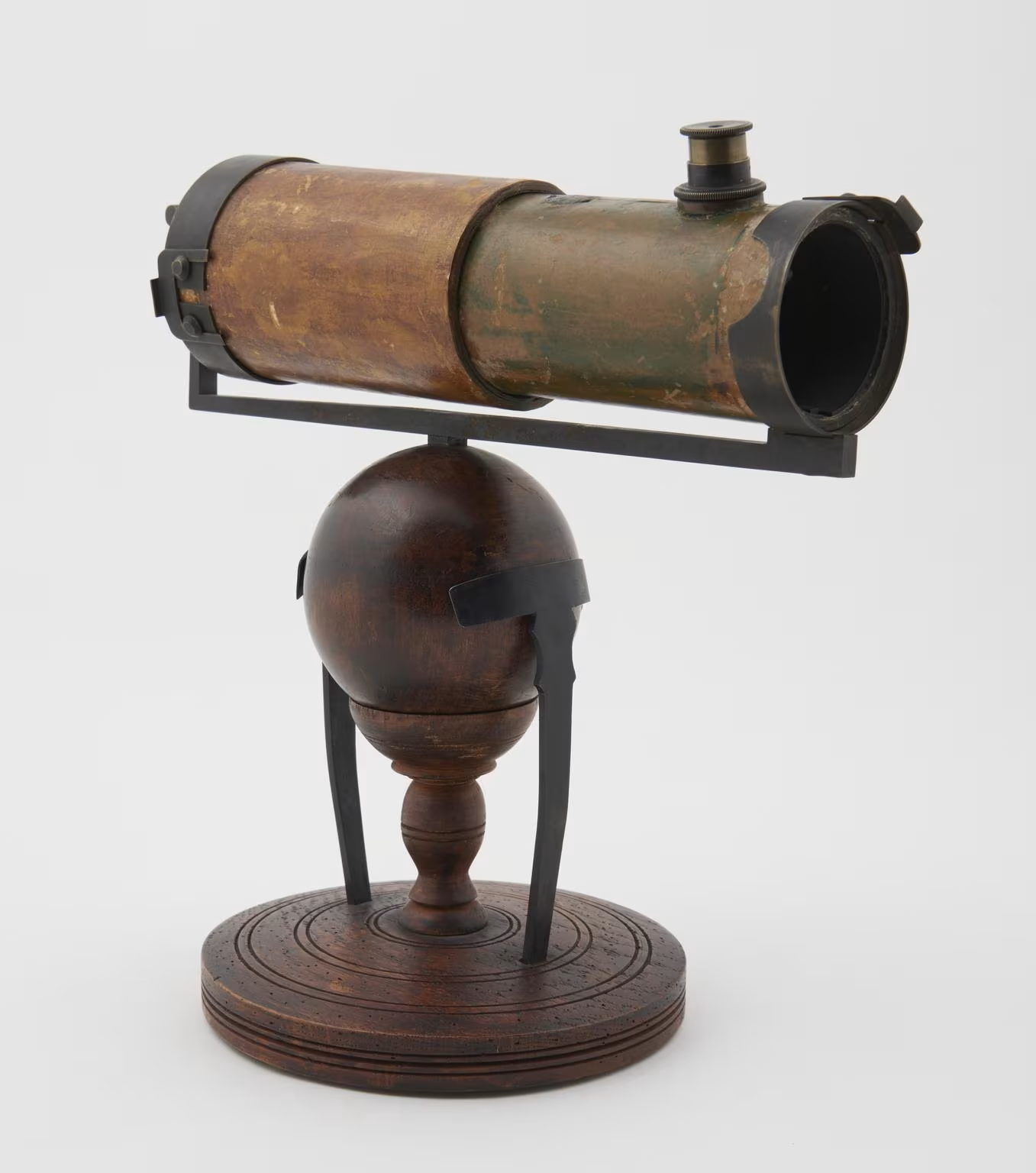
The cleanest illustration of how a modern telescope works is the one Newton built in 1668. Frustrated by the rainbow fringing that plagued every refractor of his era — light of different colours bending by different amounts as it passed through a lens, an effect we now call chromatic aberration — he replaced the front lens entirely with a concave mirror at the back of the tube. A mirror reflects all wavelengths by the same angle, so the colour fringing simply disappears. Light enters the open top of the tube, travels its full length, strikes the parabolic primary mirror, and converges back upward. Just before reaching focus it hits a small flat secondary mirror set at 45°, which deflects the converging cone out through the side wall of the tube into the eyepiece. The whole instrument was barely 15 centimetres long with a 3.3-centimetre speculum-metal primary, yet it outperformed refractors five times its size.
This layout is now called a Newtonian reflector, and almost every serious telescope built since — from the home Dobsonian on a tripod to the 6.5-metre segmented giant of JWST — is a variation on the same idea: a curved primary mirror that does the optical work, and a smaller secondary that folds the light path to a usable focus. The modern amateur reflector is essentially Newton's design with a precision-figured glass mirror, an aluminised reflective coating, a computerised mount, and a CCD camera at the focus. Four centuries of materials science have not changed the optical principle.
Why mirrors won
Lenses and mirrors trade off in three ways. (1) Chromatic aberration is fundamental to refractors and absent from reflectors. Achromatic doublets (crown plus flint glass) cancel it at two wavelengths; apochromats add a third element to cancel it at three; nothing eliminates it entirely. (2) A lens must be supported only at the rim — light has to pass through it — so it sags under its own weight as it gets bigger. The largest refractor ever built, the Yerkes 40-inch (1897), is essentially the size limit. A mirror can be supported from behind across its full back surface, so it can be made much larger and lighter. (3) A lens absorbs light at every internal interface, especially in the ultraviolet and infrared. A coated mirror reflects efficiently across a much wider band. For all three reasons, every research telescope built since the early twentieth century is a reflector.
Variations on the Newtonian theme
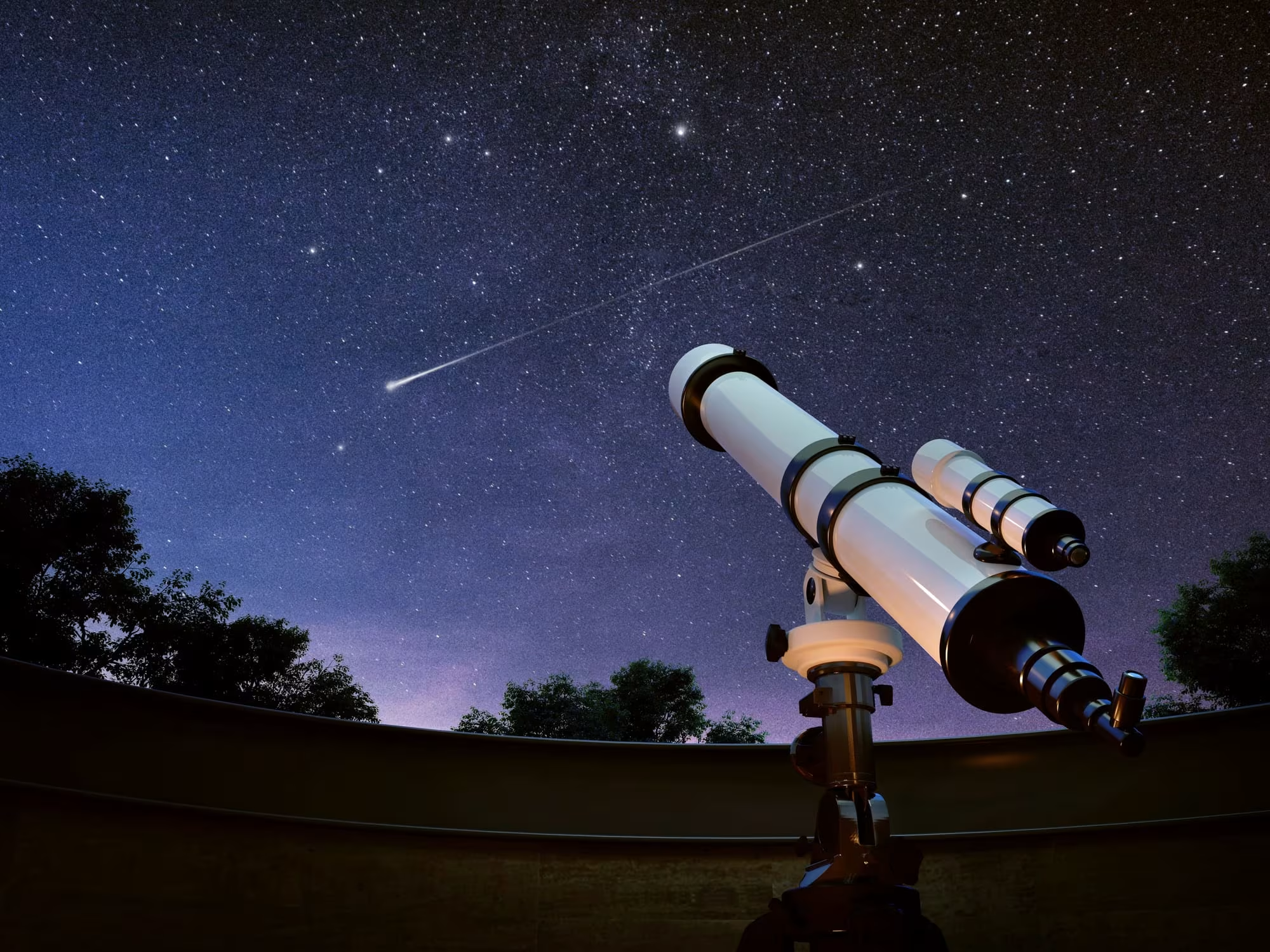
Folding the light path differently gives different families. The Cassegrain uses a convex secondary that sends the converging cone back through a hole in the primary, producing a long effective focal length in a short tube — compact and ideal for spacecraft. The Ritchey–Chrétien, used in Hubble and most modern professionals, is a Cassegrain with hyperbolic mirrors that eliminate the off-axis blur called coma, giving sharp images across a wide field. The Schmidt–Cassegrain and Maksutov–Cassegrain add a thin corrector plate at the front to fix spherical aberration in a spherical (and therefore cheap to figure) primary; these are the workhorses of consumer astronomy, the kind of telescope that fits on a dining table and still resolves Saturn's rings and the cloud bands of Jupiter.
Space telescopes — why leave the planet
For four hundred years, the limit on optical astronomy was not the telescope but the air above it. Earth's atmosphere does three bad things to incoming light. It scatters and absorbs — most of the ultraviolet is gone before it reaches the ground, the infrared is chopped into narrow windows by water vapour, and X-rays don't make it at all. It glows at infrared wavelengths because warm air is itself a thermal radiator. And it boils — turbulent cells of varying refractive index continuously distort the wavefront of incoming light, smearing point sources into a fuzzy disc several arcseconds across. Even a perfect telescope on the ground can only match the sharpness of a small one in space, because the air sets the floor on what you can resolve. This atmospheric blurring is what astronomers call seeing, and it is the reason the great observatories sit on the highest, driest, most stable mountaintops on Earth — and the reason the very best instruments are now built to fly above it.
Ground-based observatories fight the atmosphere with adaptive optics: a deformable mirror, behind the primary, that flexes hundreds of times per second to undo the wavefront distortions measured by sensing a bright reference star (or, increasingly, a laser-induced artificial star projected high in the sodium layer of the upper atmosphere). It works astonishingly well — modern 8-metre instruments can match Hubble's resolution in the infrared. But it cannot recover what the air absorbs, and it cannot make the ground sky as dark as space.
Hubble Space Telescope (1990)
Hubble was the first true general-purpose space observatory: a 2.4-metre Ritchey–Chrétien reflector in low Earth orbit, sensitive from the near-ultraviolet through the visible to the near-infrared. Above the atmosphere, its diffraction-limited resolution is about 0.05 arcseconds — better than any ground-based optical telescope at the time of its launch. A famous flaw in the primary mirror's figure was repaired in 1993 by astronauts installing corrective optics (COSTAR), and Hubble has been refurbished four more times since by Space Shuttle servicing missions. The Hubble Deep Field and Ultra Deep Field — long exposures of seemingly empty patches of sky that turned out to contain thousands of galaxies — rewrote our picture of cosmic history.
James Webb Space Telescope (JWST, 2021)
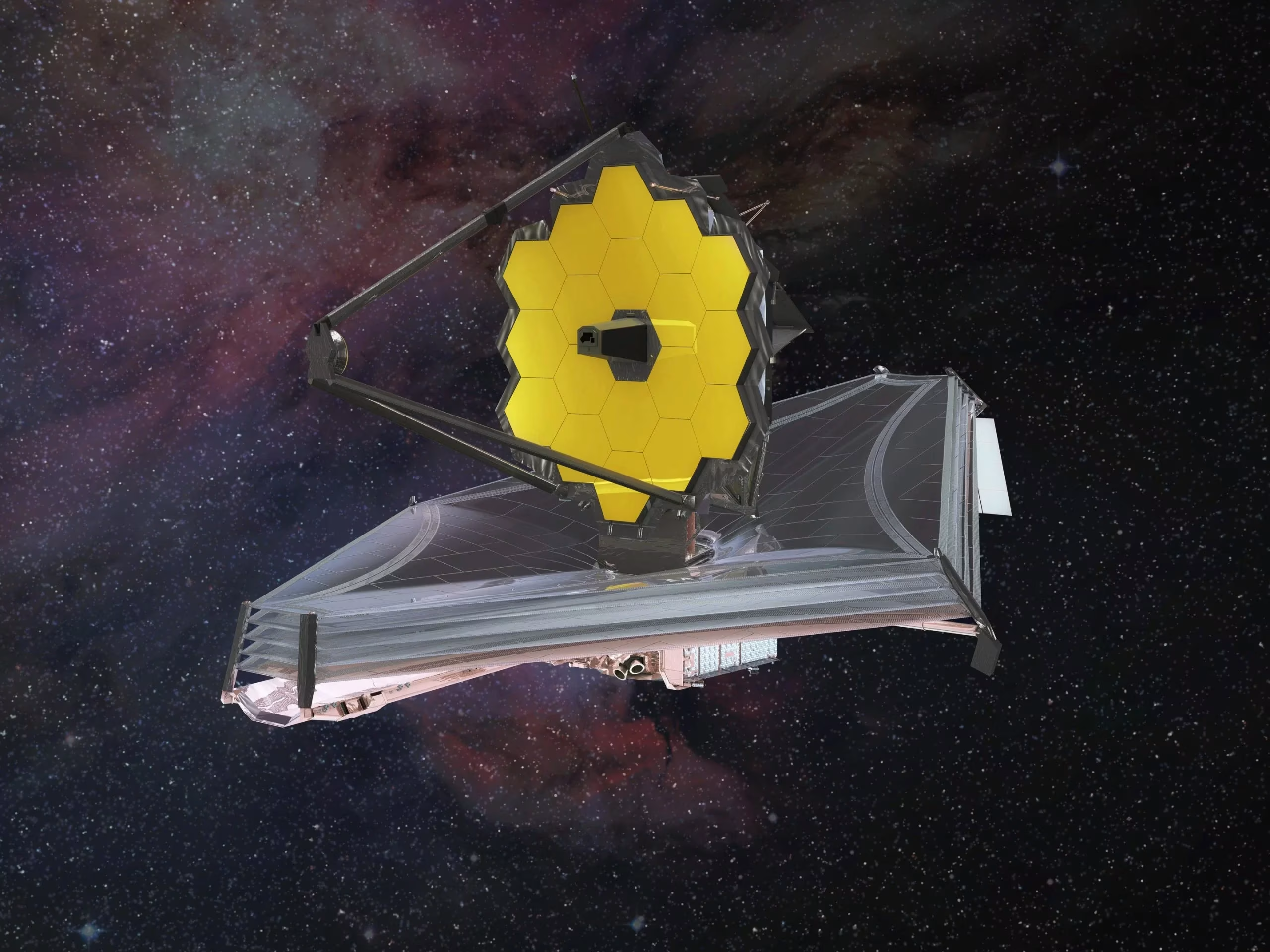
JWST is a different kind of instrument. Where Hubble looks in visible light from low Earth orbit, JWST is built for the infrared and lives a million miles from home, at the second Sun–Earth Lagrange point (L2). The two design choices are connected.
Why infrared. Distant galaxies are receding from us so fast that their light is stretched by cosmological redshift — what was emitted as ultraviolet or visible light arrives at Earth as infrared. To see the first galaxies, formed a few hundred million years after the Big Bang, you have to look in the infrared. Infrared also penetrates dust, which lets JWST peer inside star-forming regions and the disks where planets are being assembled. And infrared spectroscopy is how you read the chemical composition of an exoplanet's atmosphere as the planet transits in front of its star.
Why L2. L2 is one of the five Lagrange points where the gravity of the Sun and Earth combine with orbital motion to produce a stable equilibrium. At L2, a spacecraft orbits the Sun in lockstep with Earth, always on the night side, in a region that is permanently shielded from solar radiation. JWST does not sit exactly at L2 — it follows a wide halo orbit around the point, kept on station by tiny periodic thruster firings — but the Sun, Earth, and Moon are always on the same side of it. That matters because of the next design choice.
The sunshield. An infrared telescope cannot tolerate warmth. Anything above a few tens of kelvins is itself a bright infrared source, and would drown the telescope in its own thermal glow. JWST carries a five-layer sunshield the size of a tennis court (about 21 × 14 m). Each layer is a thin sheet of aluminised Kapton; together they reflect away the heat of the Sun, Earth, and Moon, dropping the temperature on the telescope side from roughly 85 °C on the sunward face to about −233 °C (40 K) on the cold side. The mid-infrared instrument MIRI sits inside its own additional cryocooler to reach 7 K. The sunshield is the reason JWST had to be folded for launch and unfurled in space — a sequence of more than 300 single-point failure mechanisms that all had to work, and did.
The mirror. The 6.5-metre primary is too large to fit inside any rocket fairing, so it is built as 18 hexagonal segments of beryllium, each polished to a few nanometres of figure error and coated with a thin layer of gold (gold reflects infrared more efficiently than aluminium). The segments unfolded after launch and were aligned by a months-long wavefront sensing process — measuring the diffraction pattern of bright stars and adjusting the position and tilt of each segment with seven actuators apiece, until all 18 acted as a single 6.5-metre mirror. Beryllium was chosen because it is light, stiff, and barely changes shape as it cools.
What it sees. JWST has already confirmed galaxies at redshift z > 13 — light that left them only ~330 million years after the Big Bang. It has resolved the atmospheres of exoplanets hundreds of light-years away, detecting carbon dioxide, methane, and water vapour in their transit spectra. It is currently mapping star formation inside dust clouds that Hubble could not penetrate. Each of those results required all four of the design choices above to work: the orbit, the cooling, the segmented mirror, and the infrared instruments behind it.
Beyond visible and infrared
The word telescope now extends across the entire electromagnetic spectrum. Radio telescopes use parabolic dishes or arrays of dipole antennas, with apertures synthesised from continent-spanning interferometers (the Event Horizon Telescope is the entire Earth pretending to be one dish). X-ray telescopes use grazing-incidence nested mirrors because X-rays would punch straight through anything they hit at normal incidence — the reflection only works at angles below about a degree. Gamma-ray telescopes don't focus at all; they detect cascades of particles produced when high-energy photons hit the upper atmosphere or a dense target. Gravitational-wave detectors like LIGO are telescopes for ripples in spacetime itself, and use kilometre-scale laser interferometers in place of mirrors and lenses.
The telescope did not just extend the eye. It rewrote astronomy. Within a year of Galileo pointing one at the sky, the Moon had craters, Jupiter had moons, Venus had phases, and the Milky Way was a crowd of stars. None of that fit the ancient picture of a perfect, unchanging heavens. Four centuries later, the descendants of that cardboard tube look back far enough in time to see galaxies as they were when the universe was a few hundred million years old. The instrument is the same — gather more light, look further — only the engineering has changed.
History
The first telescope patent was filed by Hans Lippershey, a Dutch spectacle maker, in October 1608. Within months the device was known across Europe. Galileo heard about it in mid-1609, built his own improved version — eventually reaching about 20× magnification — and turned it skyward. His observations, published in Sidereus Nuncius (1610), were incendiary: mountains on the Moon, four satellites orbiting Jupiter, countless stars invisible to the naked eye, and the phases of Venus. Each discovery struck at the foundations of Aristotelian–Ptolemaic astronomy.
Johannes Kepler analysed the optics of Galileo's design in Dioptrice (1611) and proposed the Keplerian telescope with two convex lenses, which became the standard for astronomical work. Throughout the seventeenth century, telescopes grew longer to reduce chromatic aberration — some exceeding 30 metres — until Newton's 1668 reflector cut the Gordian knot by replacing the lens with a mirror. He built the prototype himself — casting the speculum-metal disc, grinding the curve, polishing the surface, fashioning the tube and the eyepiece — and demonstrated it to the Royal Society in 1671. The reflecting telescope has dominated serious astronomy ever since.
The eighteenth and nineteenth centuries were the age of the great reflectors. William Herschel built a series of increasingly powerful telescopes, culminating in his 40-foot reflector in 1789, with which he discovered Uranus, catalogued thousands of nebulae, and mapped the shape of the Milky Way. Lord Rosse's 72-inch Leviathan of Parsonstown (1845) was the first to resolve the spiral structure of galaxies.
The twentieth century brought the shift to mountaintop observatories, photographic plates replacing the eye, and the era of giant reflectors: the 100-inch Hooker telescope at Mount Wilson (1917), where Hubble proved the universe extends beyond our galaxy, and the 200-inch Hale telescope at Palomar (1948), which remained the world's largest for decades. Modern instruments — the Keck twins (10 m), the VLT (four 8.2 m units), and the forthcoming Extremely Large Telescope (39 m) — use segmented mirrors, laser-guide-star adaptive optics to correct for atmospheric turbulence, and interferometric techniques that were unthinkable a century ago.
The same era also democratised the instrument. Amateur reflectors built on Newton's original pattern — now with precision-figured glass mirrors, computerised GoTo mounts, and cooled CMOS cameras — routinely image galaxies and nebulae from suburban gardens that would have required a professional observatory in 1950.
The leap into space began with small ultraviolet observatories (OAO-2, IUE) in the 1960s and 1970s. The Hubble Space Telescope, launched on STS-31 in April 1990, was the first true space observatory in the modern sense — a 2.4-metre Ritchey–Chrétien optimised across the UV, visible, and near-infrared. A flaw in the primary mirror's figure was corrected in 1993 by astronauts installing the COSTAR optics package, and Hubble was serviced four more times by Space Shuttle crews, the last in 2009.
Its successor, the James Webb Space Telescope, launched on Christmas Day 2021 aboard an Ariane 5 from Kourou. Over the following month it executed the most complex deployment sequence ever attempted in space: unfolding the sunshield, tensioning all five layers, swinging the secondary mirror tower into position, and unlocking the 18 hexagonal segments of the primary. After arrival at L2 in late January 2022 and several months of mirror alignment and instrument commissioning, full science operations began in July 2022. Within months JWST had detected the most distant galaxies ever confirmed, resolved the atmospheres of exoplanets hundreds of light-years away, and produced infrared images of star-forming regions that simply could not be obtained from the ground. Four centuries separate Galileo's cardboard tube from JWST's gold-coated beryllium, but the underlying recipe has not changed: collect more light, and look further.