Johannes Kepler
Gave up on circles after eight years and found that orbits are ellipses.
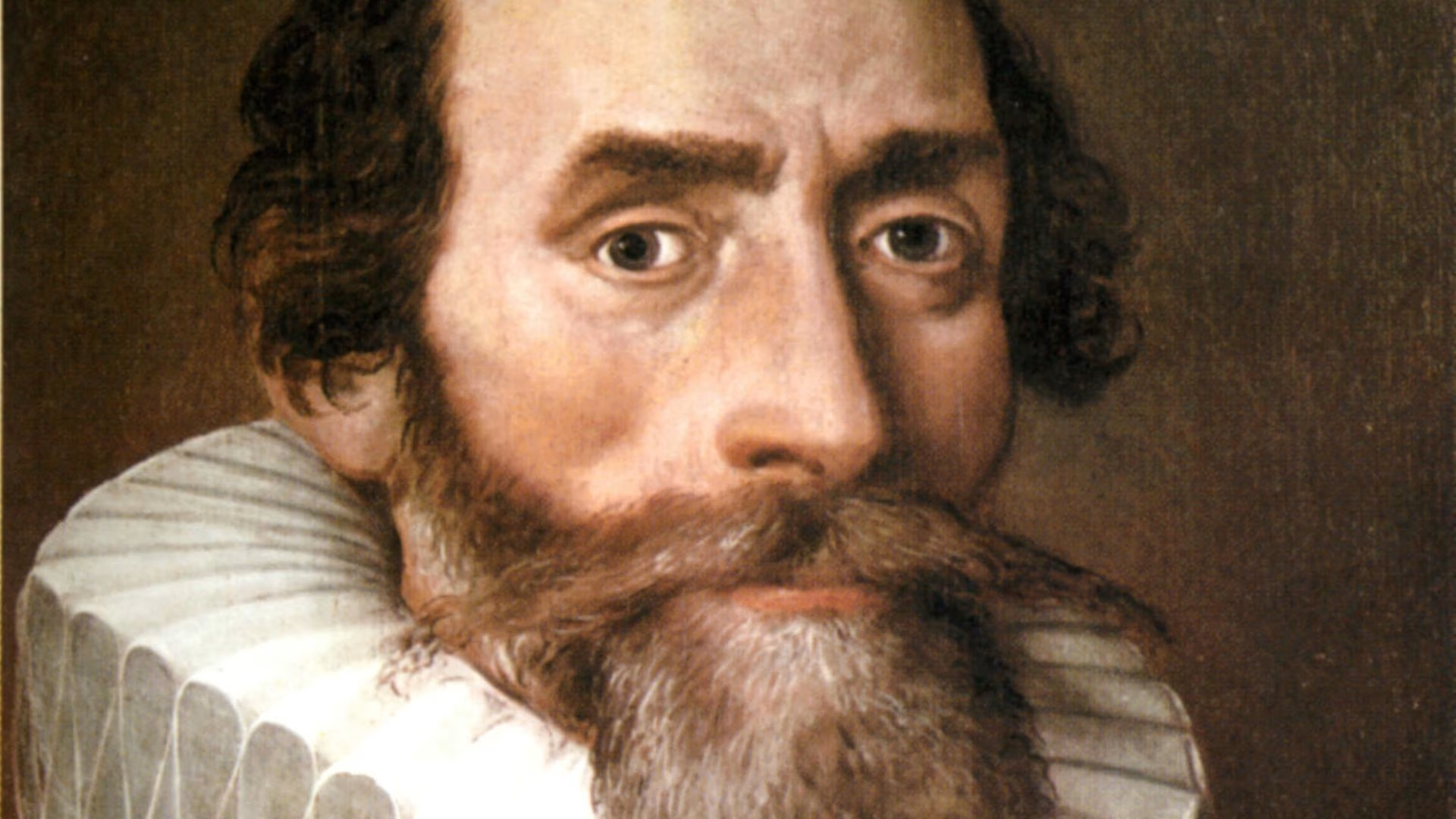
Biography
Johannes Kepler was born in 1571 in the small German town of Weil der Stadt, to a mercenary father who vanished early and a mother later accused of witchcraft. Sickly, half-blind, and deeply religious, he trained in theology before drifting into astronomy. In 1600 he joined Tycho Brahe in Prague as an assistant, and when Tycho died a year later Kepler inherited his unmatched set of planetary observations.
What followed was one of the most remarkable acts of calculation in the history of science. Kepler spent eight years trying to fit Tycho's observations of Mars to a circular orbit. Nothing worked. He tried ovals, egg shapes, every curve he could think of. In 1609 he finally let go of the two assumptions that had ruled astronomy for fifteen centuries — that orbits are circles and that planets move at constant speed — and wrote down the first two laws of planetary motion. A decade later he added the third. The three laws together — orbits are ellipses, equal areas in equal times, and the square of the period is proportional to the cube of the semi-major axis — gave the solar system its first honest mathematical description.
Kepler died in 1630, still chasing a harmony he believed God had hidden in the numbers. Newton's laws eventually explained why his rules held, but the rules themselves were Kepler's.
Contributions
- 01three laws of planetary motion (1609, 1619)
- 02derived elliptical orbits from Tycho Brahe's Mars data
- 03wrote Astronomia Nova and Harmonices Mundi
- 04improved Galileo's telescope design (Keplerian telescope)
- 05laid the empirical foundation for Newton's gravitation
Major works
Kepler's first major work, proposing that the spacing of the six known planets could be explained by the five Platonic solids nested between their orbital spheres. Wrong in detail, but it established his reputation and led him to Tycho Brahe.
The result of ten years of work on Tycho's Mars observations. Introduced the first two laws of planetary motion — elliptical orbits and equal areas in equal times — and demolished the ancient assumption of uniform circular motion.
An ambitious search for geometric harmony in the cosmos. Contains the third law of planetary motion: the square of a planet's orbital period is proportional to the cube of its semi-major axis.
A three-volume textbook extending all three laws of planetary motion to every known planet and the Moon. Became the most widely read work of Copernican astronomy in the seventeenth century.
Planetary tables computed from Tycho Brahe's observations and Kepler's elliptical astronomy. Their superior accuracy over all predecessors proved the practical value of the new orbital mechanics.