Isaac Newton
Wrote three laws of motion and one of gravity, and explained almost everything.
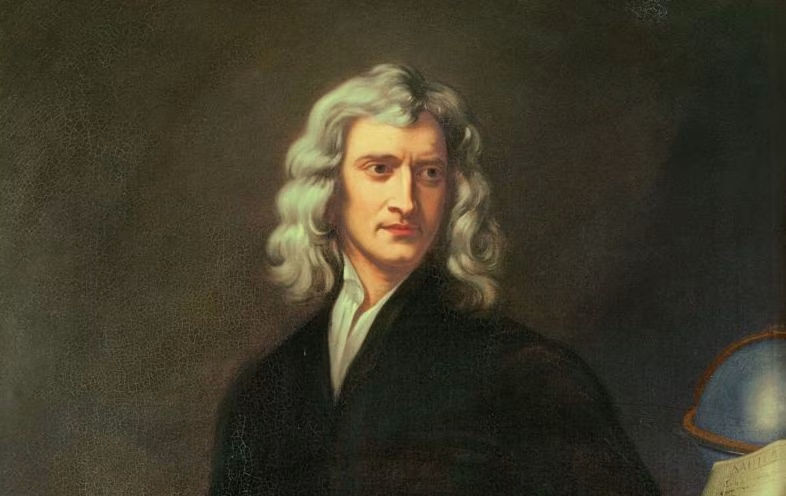
Biography
Isaac Newton was born on Christmas Day 1642 at Woolsthorpe Manor in Lincolnshire — the year Galileo died. His father had died three months before. His mother remarried when he was three and left him with his grandmother. He never forgave her for it.
At twelve he entered the King's School in Grantham, where he distinguished himself not through academics but by building sundials, windmill models, and mechanical contraptions. His mother pulled him out at seventeen to make him a farmer. He hated it. A sympathetic uncle persuaded her to send him back, and in June 1661 he arrived at Trinity College, Cambridge, as a subsizar — a student who earned his keep doing chores for wealthier ones.
Then the plague came. In August 1665, Cambridge shut its doors, and Newton went home to Woolsthorpe for two years. What followed was, by any measure, the most productive stretch of thinking in the history of science. Alone in the countryside at twenty-three, he discovered the generalised binomial theorem, invented calculus, decomposed white light into a spectrum with a prism, and began the chain of reasoning that would become universal gravitation. He told no one.
Back at Cambridge, he succeeded Isaac Barrow as Lucasian Professor of Mathematics in 1669, at twenty-six. He was a terrible teacher — his assistant Humphrey Newton noted he would cut lectures from thirty minutes to fifteen if the room was empty, then retreat to his experiments. Over his entire career he was assigned only three students.
In 1668 he built the first functional reflecting telescope — an eight-inch device that outperformed every refracting telescope in existence. He demonstrated it to the Royal Society in 1671, was elected Fellow in 1672, and published his theory of colour the same year. Robert Hooke attacked it publicly. Newton was so stung he withdrew from scientific debate for years.
The work that changed everything began with a short manuscript, De Motu Corporum in Gyrum, sent to Edmond Halley in 1684. Halley recognised its significance and urged Newton to expand it. The result, three years later, was the Philosophiæ Naturalis Principia Mathematica — the Mathematical Principles of Natural Philosophy. Published in 1687, the Principia laid out three laws of motion and a single law of universal gravitation: every mass attracts every other mass with a force proportional to their masses and inversely proportional to the square of the distance between them. From those few sentences Newton derived Kepler's three laws of planetary motion, explained the tides, predicted the trajectories of comets, described the precession of the equinoxes, inferred the oblate shape of the Earth, and provided the first quantitative estimate of the Sun's mass. The book was so dense with geometry that few contemporaries could follow it, but it unified terrestrial and celestial mechanics in one stroke — the first great unification in physics.
In 1704 he published Opticks, collecting decades of work on light, colour, refraction, and the interference patterns now called Newton's rings. Unlike the Principia, it was written in English and accessible to a wide audience.
Newton's later decades were spent in London. He became Warden of the Royal Mint in 1696, then Master in 1699 — a post he held until his death, increasing the accuracy and security of British coinage. He served as president of the Royal Society from 1703 to 1727. He was knighted by Queen Anne in 1705. He served two terms as Member of Parliament for Cambridge University.
He also spent enormous energy on things most scientists ignore. He wrote more on alchemy than on physics. He devoted years to biblical chronology and privately rejected the doctrine of the Trinity — a heresy he kept carefully hidden from the Anglican establishment. His feud with Leibniz over the invention of calculus consumed the last two decades of his life and was conducted through proxies, accusations of plagiarism, and a Royal Society investigation that Newton himself secretly authored.
He died on 31 March 1727, aged eighty-four, and was buried in Westminster Abbey. Nothing in physics was quite the same after him — and nothing would be again until Einstein.
Contributions
- 01three laws of motion (Principia, 1687)
- 02universal law of gravitation (Principia, 1687)
- 03derived Kepler's three laws from an inverse-square force
- 04co-invented calculus (method of fluxions, 1665–1666)
- 05built the first reflecting telescope (1668)
- 06decomposed white light into a spectrum (1666)
- 07explained the tides, comets, and precession of the equinoxes
- 08published Opticks (1704) — colour theory and Newton's rings
- 09first theoretical calculation of the speed of sound
- 10formulated Newton's law of cooling
- 11first quantitative estimate of the Sun's mass
- 12generalised binomial theorem (1664–1665)
Major works
Three laws of motion and universal gravitation. Derived Kepler's laws, explained tides, comets, precession, and the shape of the Earth. The foundation of classical mechanics.
Light, colour, refraction, and interference. Demonstrated that colour is intrinsic to light, described Newton's rings, and theorised on the particle nature of light.
Short manuscript on orbital mechanics sent to Edmond Halley. The seed that became the Principia.
Newton's calculus notation system. Circulated in manuscript for decades before publication. Introduced polar coordinates in a strictly analytic sense.
Textbook on algebra compiled from Newton's Cambridge lecture notes. Established the method of substitution and elimination for solving simultaneous equations.