Joseph-Louis Lagrange
Rewrote mechanics without a single diagram and found the five points where gravity stands still.
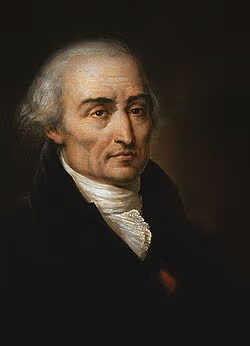
Biography
Giuseppe Luigi Lagrangia — later Joseph-Louis Lagrange — was born in Turin and spent his career in Berlin and Paris, becoming one of the greatest mathematicians in history. His masterwork, Mécanique analytique (1788), reformulated all of Newtonian mechanics using pure algebra and calculus, without a single geometric figure. He was reportedly proud of this: the preface announces that the reader will find no diagrams in the entire book.
Lagrange's reformulation replaced Newton's forces with a single scalar function — the Lagrangian L = T − V (kinetic minus potential energy) — and derived all equations of motion from a variational principle: the true path between two points is the one that makes the action integral stationary. This approach handles constraints, curved coordinates, and coupled systems with an elegance that Newton's vector forces cannot match.
In 1772, while studying the three-body problem, Lagrange discovered that there are exactly five points (now called Lagrange points) where a small body can remain in equilibrium relative to two larger orbiting bodies. Three lie on the line connecting the two bodies; two form equilateral triangles. The triangular points (L4 and L5) are stable — a prediction confirmed in 1906 when the first Trojan asteroid was discovered at Jupiter's L4 point.
Lagrange survived the French Revolution (unlike his friend Lavoisier), served on the commission that created the metric system, and taught at the École Polytechnique until his death in 1813. His analytical mechanics remains the foundation of theoretical physics: every path from classical mechanics to quantum field theory passes through the Lagrangian.
Contributions
- 01reformulated mechanics using the Lagrangian L = T − V (Mécanique analytique, 1788)
- 02discovered the five Lagrange points in the three-body problem (1772)
- 03developed the calculus of variations
- 04contributed to number theory (Lagrange's four-square theorem)
- 05helped create the metric system during the French Revolution
Major works
The first comprehensive treatise on mechanics using purely analytical methods. Replaced geometric reasoning with the calculus of variations and introduced generalised coordinates, transforming mechanics from a branch of geometry into a branch of analysis.
Analytical treatment of the restricted three-body problem. Discovered the five equilibrium points (Lagrange points) and proved the stability of the triangular points L4 and L5.