pendulum clock
Mechanical clock regulated by a swinging pendulum; first accurate timekeeper, built by Huygens in 1656.
Definition
A pendulum clock uses the steady swing of a weighted rod as its timing element. The underlying physics is elegant: for small amplitudes, the period T = 2π√(l/g) depends only on the pendulum's length and the local gravitational acceleration. Neither the mass of the bob nor the size of the swing matters — a property called isochronism. This means you can tune a pendulum clock once by adjusting the rod length and it will keep time for years with very little drift.
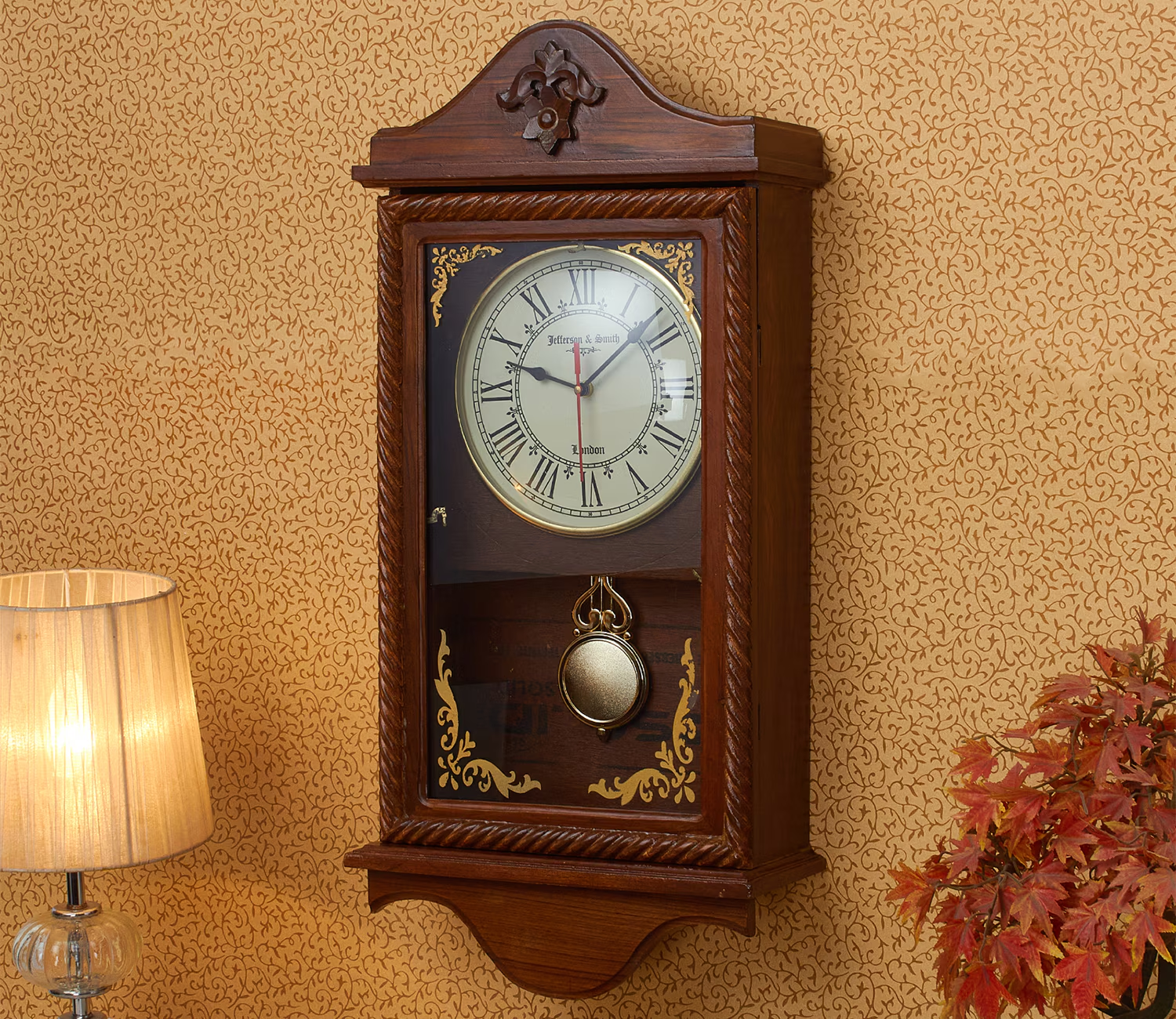
The mechanism works through an escapement — a toothed wheel that advances by exactly one tooth per swing, converting the pendulum's continuous oscillation into discrete ticks. The escapement also delivers a small impulse to the pendulum on each cycle, replacing the energy lost to air resistance and friction at the pivot. A falling weight or a coiled spring provides the energy source. The genius of the design is that the escapement couples the timekeeping element (the pendulum) to the energy source without disturbing the pendulum's natural frequency.
The quality of the escapement sets the ultimate precision. The earliest pendulum clocks inherited the verge-and-foliot mechanism from pre-pendulum tower clocks, which wasted energy and disturbed the swing on every tick. The anchor escapement, introduced around 1657, delivered impulses more gently and became the standard for nearly two centuries. George Graham's deadbeat escapement (1715) eliminated the tiny backward push the anchor gave on every tick and became the heart of every precision regulator that followed. John Harrison's grasshopper escapement was nearly frictionless and needed almost no lubrication. The ultimate refinement was William Hamilton Shortt's free-pendulum clock of 1921, in which a master pendulum swung in a near-vacuum and received its impulse from a slave clock once every half minute — the master itself was effectively untouched, and the pair kept time to within a few milliseconds per day.
Several types of pendulum clock emerged over the centuries. Longcase clocks (grandfather clocks) housed a seconds pendulum — about one metre long, with a two-second period — inside a tall wooden case. Regulators were high-precision observatory clocks with minimal ornamentation, temperature-compensated pendulums, and jewelled bearings, achieving accuracies of a few hundredths of a second per day. Wall regulators and Vienna regulators were lighter, simpler variants for domestic and commercial use. Marine chronometers, though often spring-driven, sometimes incorporated pendulum-like balances for land-based astronomical timekeeping.
For nearly three hundred years — from the mid-seventeenth century until the arrival of quartz oscillators in the 1930s — the pendulum clock was the most accurate timekeeper in the world. Its influence on science was immense: it made precise measurement of time routine, enabled the synchronisation of astronomical observations across continents, and turned the study of gravity into an exact science. Variations in g from place to place were first detected by the slight speeding up or slowing down of pendulum clocks transported between latitudes.
History
Galileo first observed the isochronism of the pendulum in 1583, reportedly timing the swings of a chandelier in Pisa cathedral against his own pulse. He sketched designs for a pendulum-regulated clock late in life, but never built one. His son Vincenzo began construction in 1649 but died before finishing it.
Christiaan Huygens, working independently, designed and built the first working pendulum clock in 1656, patented in 1657. His clocks were immediately ten to sixty times more accurate than any previous timekeeper, reducing daily errors from fifteen minutes to about fifteen seconds. Huygens also recognised the theoretical limitation: a circular pendulum is only approximately isochronous. In his masterwork Horologium Oscillatorium (1673), he proved that a cycloidal pendulum — one whose bob follows a cycloid rather than a circular arc — is perfectly isochronous at all amplitudes, and he built clocks with cycloidal cheeks at the pivot to enforce this path.
The eighteenth century brought refinements in temperature compensation. George Graham invented the mercury pendulum around 1721, in which the thermal expansion of a mercury column in the bob raised the centre of mass to counteract the lengthening of the rod. John Harrison, better known for his marine chronometers, devised the gridiron pendulum using alternating rods of brass and steel whose expansions cancelled. By the late nineteenth century, observatory regulators by Riefler and Shortt achieved errors below ten milliseconds per day — a precision that stood until electronic oscillators arrived.
The pendulum clock's decline began in the 1920s with quartz crystal oscillators and was sealed by the caesium atomic clock in 1955. But for three centuries, every advance in timekeeping, navigation, geodesy, and experimental physics depended on the swinging pendulum.