Christiaan Huygens
Built the first pendulum clock and turned a curiosity into a timekeeper.
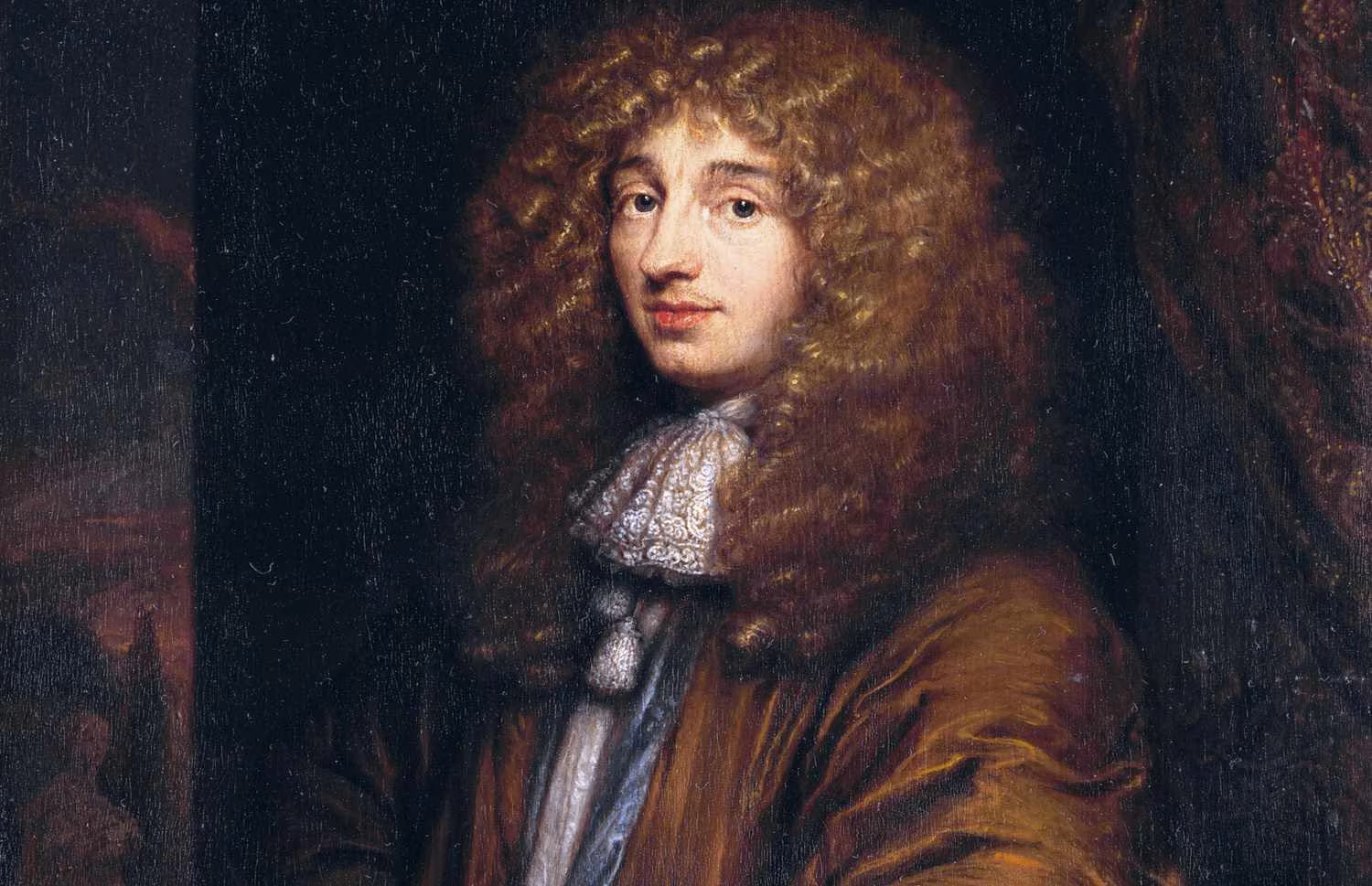
Biography
Christiaan Huygens was born in The Hague in 1629 into a wealthy and well-connected Dutch family. He trained as a mathematician, then spent his life moving between astronomy, mechanics, and optics with a quiet, almost obsessive precision. In 1656, building on Galileo's isochronism, he designed and constructed the first working pendulum clock. It was the most accurate timekeeper the world had ever seen, losing only about a minute a day where its predecessors lost a quarter of an hour. Within a decade, pendulum clocks were standard across Europe and the problem of finding longitude on land was essentially solved.
In parallel he ground his own telescope lenses, and in 1655 he discovered Titan, Saturn's largest moon. A few years later he correctly explained Saturn's strange appearance: the planet is encircled by a thin, flat ring. He published the wave theory of light in Traité de la Lumière in 1690, where he treated light as a disturbance propagating through a medium — an idea that would be eclipsed by Newton's corpuscles for a century before returning in triumph.
Huygens died in 1695. He is one of the few figures in seventeenth-century science who belongs equally to mechanics, astronomy, and optics.
Contributions
- 01built the first pendulum clock (1656)
- 02wave theory of light (Traité de la Lumière, 1690)
- 03discovered Titan, Saturn's largest moon
- 04explained the rings of Saturn
- 05derived the formula for centripetal force
Major works
The most important work on telescopic astronomy since Sidereus Nuncius. Correctly explained Saturn's ring system and provided refined measurements of planetary distances from the Sun.
One of the three landmark works on mechanics in the seventeenth century. Presented pendulum clock designs, solved the tautochrone problem, developed the theory of evolutes, and derived centripetal force.
Set out the wave theory of light, treating it as a disturbance propagating through a medium. Explained reflection and refraction, and derived the law of double refraction in Iceland spar.
Published posthumously. Speculated on the possibility of extraterrestrial life and described the physical conditions on other planets, making it one of the earliest works of popular astronomy.