quadrant
Pre-telescope astronomical instrument for measuring the angular position of stars and planets.
Definition
A quadrant is, in its simplest form, a quarter-circle of wood or metal marked with degrees. You sight a star along one edge and read its altitude above the horizon from a plumb line or a pointer. Larger, wall-mounted versions — mural quadrants — could be several metres across and fixed to a stone wall aligned with the meridian.
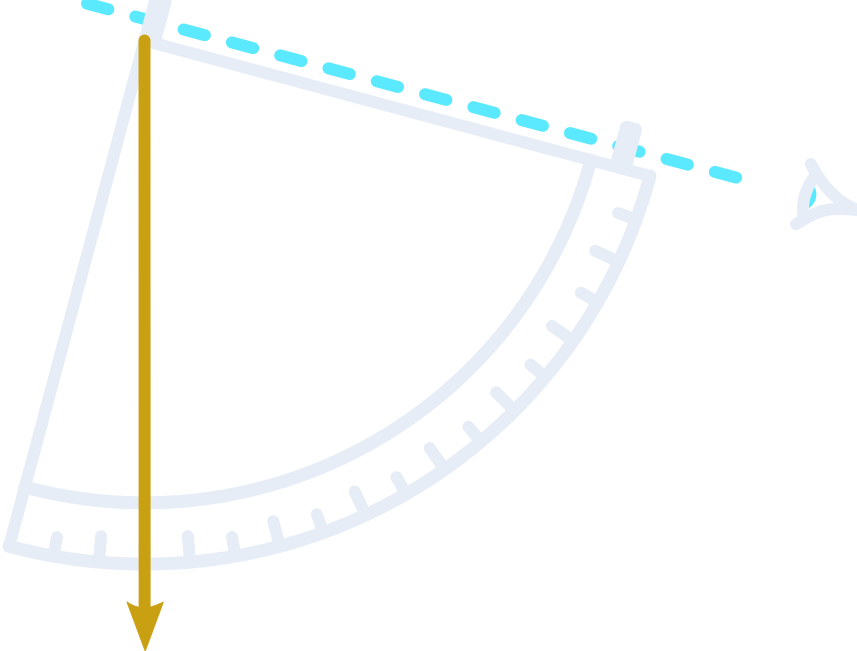
Before the telescope, the quadrant was how astronomers turned the night sky into numbers. The bigger the instrument, the finer the angles it could resolve.
History
Tycho Brahe's mural quadrant at Uraniborg, built in the 1580s, had a radius of about two metres and reached an accuracy of roughly one arcminute — close to the theoretical limit of the naked eye. It is the instrument that produced the Mars data Kepler later used to derive his laws of planetary motion.