Tycho Brahe
Measured the sky by naked eye more accurately than anyone ever would again.
Biography
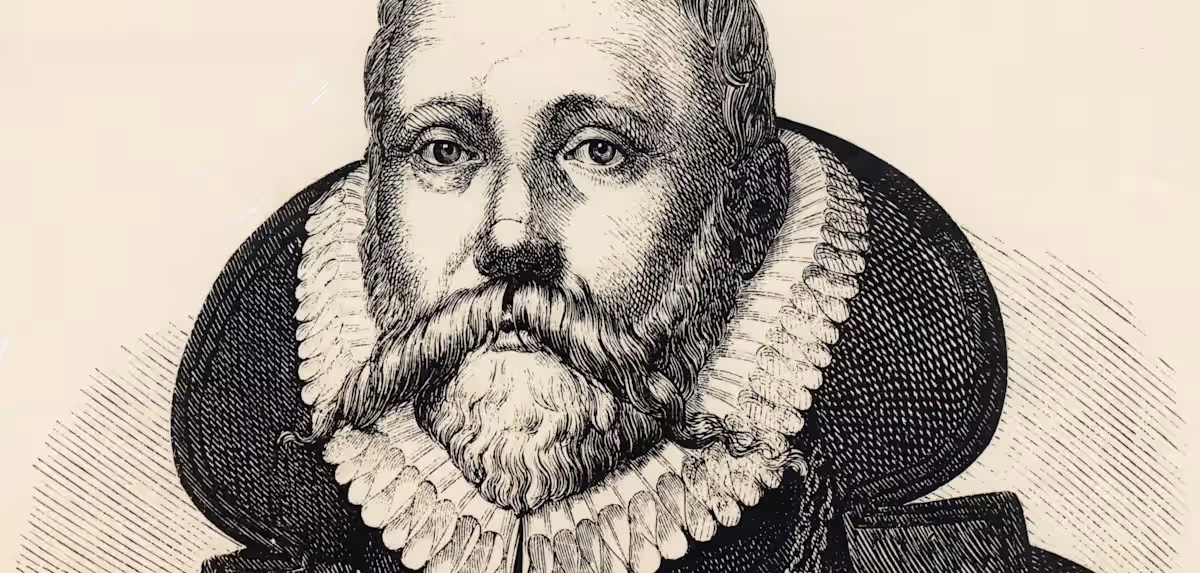
Tycho Brahe was born in 1546 into the Danish nobility. He lost part of his nose in a duel as a young man and wore a metal prosthetic for the rest of his life. In 1572 he observed a new star — a supernova — in the constellation Cassiopeia, and showed that it lay far beyond the Moon, in a region of the heavens that Aristotle had insisted must be unchanging. It was a direct blow to the ancient cosmos.
The Danish king was impressed enough to give Tycho the island of Hven and the money to build Uraniborg, the most expensive scientific instrument of the sixteenth century. For twenty years, Tycho and his assistants used massive mural quadrants and sextants to measure the positions of stars and planets with a precision no one had ever achieved and no one would match without a telescope. His measurements of Mars, in particular, were accurate to about one arcminute — good enough to break the ancient circular-orbit model once someone thought to look closely.
That someone was Johannes Kepler, who joined Tycho in Prague in 1600. When Tycho died the following year — famously and probably falsely, of a burst bladder at a banquet — Kepler inherited his data and turned it into the laws of planetary motion. The telescope age began a decade later, but nothing in it would have been possible without Tycho's naked eye.
Contributions
- 01most accurate pre-telescope astronomical observations in history
- 02built the Uraniborg observatory on Hven
- 03observed the 1572 supernova and proved it was beyond the Moon
- 04showed comets are celestial, not atmospheric, objects
- 05left the data set that enabled Kepler's laws
Major works
Tycho's analysis of the 1572 supernova in Cassiopeia, proving through parallax measurements that the new star lay far beyond the Moon. A direct challenge to the Aristotelian doctrine of an unchanging celestial sphere.
A study of the great comet of 1577, demonstrating that it moved through the planetary region rather than the atmosphere. Also introduced the Tychonic system, a geo-heliocentric model placing the Sun in orbit around the Earth while the other planets orbit the Sun.
A lavishly illustrated catalogue of the instruments at Uraniborg and Stjerneborg. Described the design and use of Tycho's mural quadrants, armillary spheres, and sextants in unprecedented technical detail.
Published posthumously by Kepler. A comprehensive treatise on the 1572 supernova and a revised star catalogue of over 1,000 stars, the most accurate before the telescope era.