Urbain Le Verrier
Found a new planet with pen and paper before anyone pointed a telescope at it.
Biography
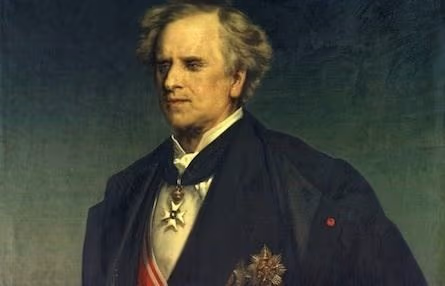
Urbain Le Verrier was born in Normandy in 1811 and trained as a chemist before switching to celestial mechanics at the Paris Observatory. He was a superb calculator and a difficult colleague. In the 1840s he set out to explain the motion of Uranus, which had been drifting away from its predicted orbit for decades in a way that Newtonian gravity could not account for — unless another, unseen planet was tugging on it.
Le Verrier worked out where that planet would have to be. In September 1846 he sent his coordinates to Johann Galle at the Berlin Observatory. Galle pointed his telescope at the predicted spot that same night and found Neptune, within a degree of Le Verrier's prediction. It was the most spectacular confirmation of Newtonian mechanics ever performed. A planet had been discovered by mathematics.
Le Verrier went on to direct the Paris Observatory and to study the perihelion of Mercury, which also drifts in a way Newton's laws cannot quite explain. He assumed there must be another unseen planet — he called it Vulcan — but this time he was wrong. The Mercury anomaly would wait for Einstein's general relativity to be resolved in 1915.
Contributions
- 01predicted Neptune's position from perturbations in Uranus's orbit (1846)
- 02directed the Paris Observatory
- 03identified the anomalous precession of Mercury's perihelion
- 04built tables of planetary motion used for decades
Major works
A 254-page memoir predicting the position of an unseen planet perturbing Uranus. Johann Galle found Neptune within one degree of Le Verrier's coordinates the night he received the letter.
Le Verrier's first major work on Mercury's orbit. Laid the groundwork for his later discovery that Mercury's perihelion precesses faster than Newtonian mechanics can explain.
Reported the anomalous advance of Mercury's perihelion — 38 arc-seconds per century unaccounted for by known planets. The discrepancy was not resolved until Einstein's general relativity in 1915.
Comprehensive tables of planetary motion that became the standard reference for French and international ephemerides for the rest of the nineteenth century.