Thomas Young
Polymath who introduced the word energy to physics, in its modern sense.
Biography
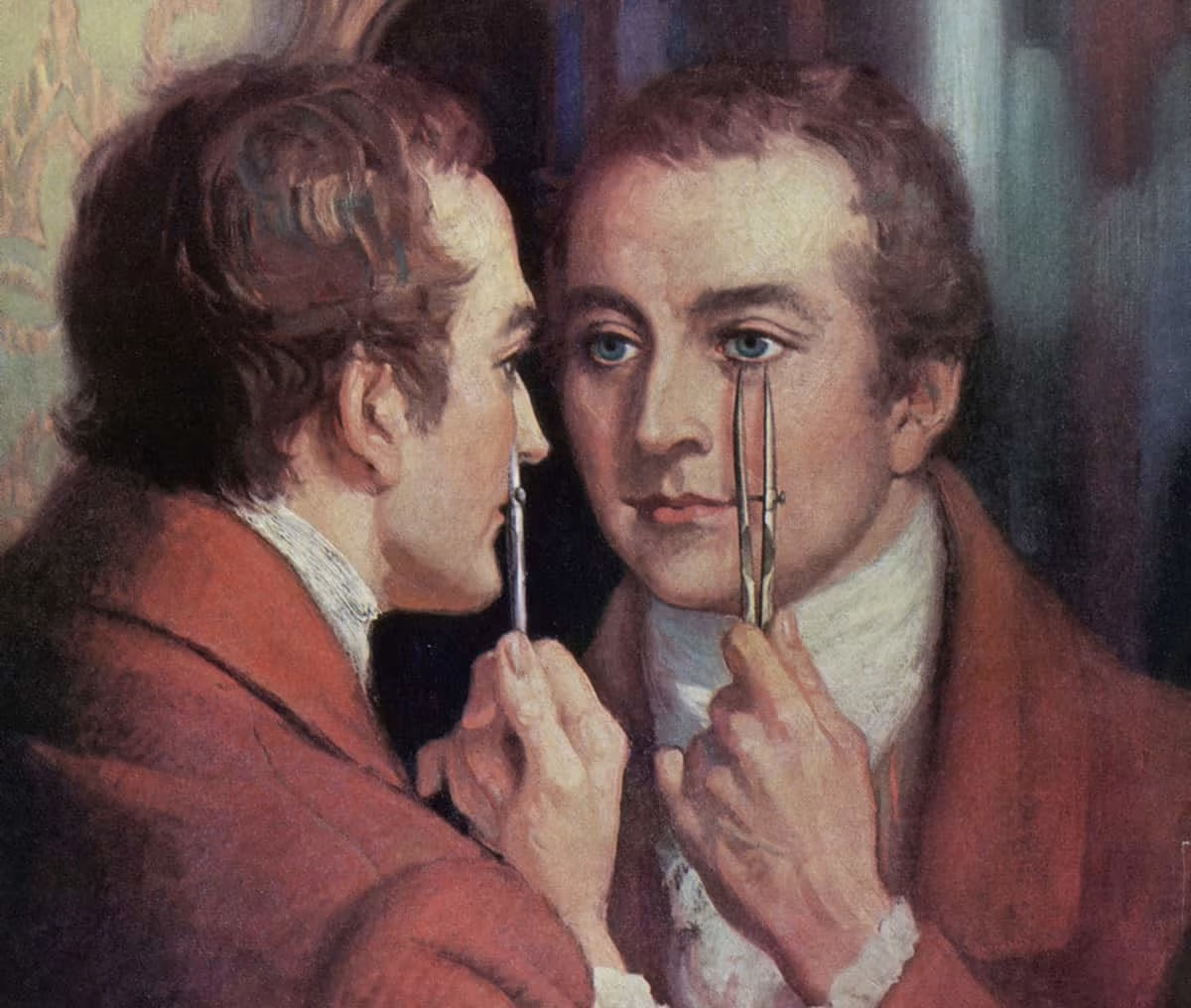
Thomas Young was born in Milverton, Somerset, in 1773. A child prodigy fluent in Greek and Latin by age six, he trained as a physician but spent most of his career as an independent scholar in London. His output spans physics, physiology, Egyptology, and linguistics — he contributed substantially to the decipherment of the Rosetta Stone — and he published a large part of his scientific work anonymously to avoid damaging his medical practice.
In physics he is remembered for the double-slit experiment of 1801–1803, which demonstrated interference of light and revived the wave theory against Newton's corpuscular orthodoxy. Equally important, though less famous, was his 1807 introduction of the word energy in its modern technical sense — the first time the term was used in English scientific writing to describe the quantity ½·m·v², replacing the older and vaguer vis viva. He also named Young's modulus — the elastic constant relating stress to strain — and studied the physiology of vision and colour.
He died in London in 1829. His gravestone in Westminster Abbey calls him one who "brought to the studies that interested him a variety of knowledge such as few men have ever possessed".
Contributions
- 01demonstrated the wave nature of light with the double-slit experiment (1803)
- 02introduced the scientific term 'energy' in its modern sense (1807)
- 03defined Young's modulus in elasticity
- 04contributed to the decipherment of Egyptian hieroglyphs
- 05formulated the three-component theory of colour vision