Robert Hooke
The Royal Society's polymath curator — springs, cells, and a bitter rivalry with Newton.
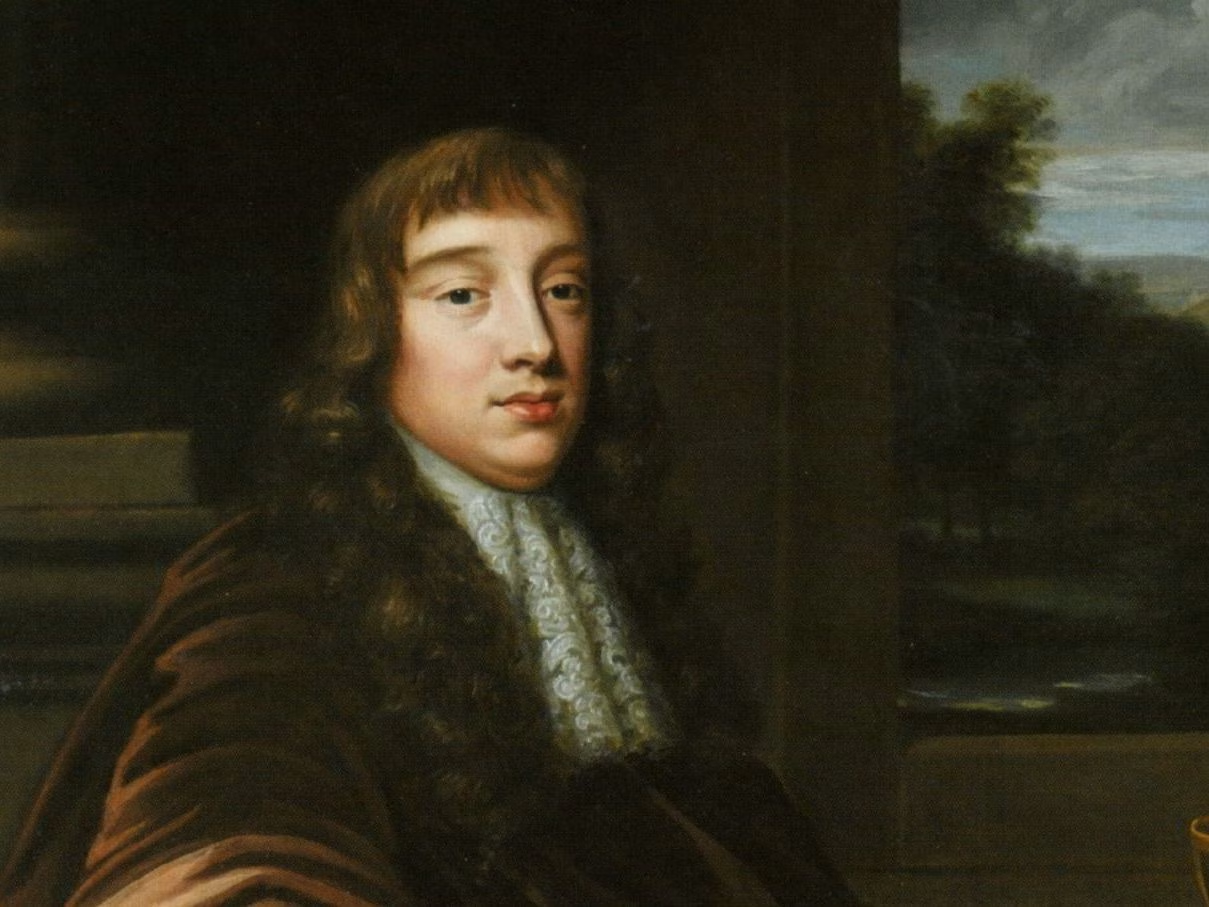
Biography
Robert Hooke was born on the Isle of Wight in 1635, the son of a curate. A sickly child, he taught himself mechanical drawing and model-making, and went up to Christ Church, Oxford, as a servitor. There he fell in with the experimental philosophers around John Wilkins and Robert Boyle, for whom he built the air pump used in the famous vacuum experiments.
When the Royal Society was founded in 1660, Hooke became its first Curator of Experiments — required to produce three or four new demonstrations at every weekly meeting. For forty years he did exactly that, across an astonishing range of fields. He improved the compound microscope and published Micrographia (1665), coining the word 'cell' for the box-like structures he saw in cork. He formulated what is now called Hooke's law — that the restoring force of a spring is proportional to its displacement — and published it in 1678 in the anagrammatic form ceiiinosssttuv, which unscrambles to ut tensio, sic vis.
He was the City of London's Surveyor after the Great Fire of 1666, working alongside Christopher Wren to rebuild the capital. And then there was the quarrel with Newton. Hooke had been writing to Newton since the 1670s, claiming — with some justification — that he had glimpsed the inverse-square law of gravitation before Newton did. He could not prove the orbits were ellipses. Newton could. When the Principia appeared in 1687, Hooke demanded public credit; Newton grudgingly added a brief acknowledgement and then privately cultivated a durable hatred. After Hooke's death in 1703, Newton — then President of the Royal Society — is said to have had the only portrait of Hooke removed. No authenticated image of him survives.
Contributions
- 01formulated Hooke's law of elasticity (1678) — F = −kx
- 02coined the word 'cell' in biology (Micrographia, 1665)
- 03advanced the compound microscope and published the first great microscopy book
- 04proposed an inverse-square law of gravitational attraction in correspondence with Newton (1679)
- 05designed the City of London with Christopher Wren after the Great Fire of 1666
- 06built the air pump used by Boyle in the vacuum experiments
- 07was the first Curator of Experiments at the Royal Society
Major works
The first great book of microscopy. Folding plates of fleas, louse grips, fossils, and cork tissue — where Hooke named the box-like structures 'cells', giving biology its foundational word.
The publication of Hooke's law of elasticity — ut tensio, sic vis. Contains applications to springs, watch balances, and the theory of sound.
A short lecture in which Hooke states the programme of universal gravitation: all celestial bodies attract each other with a force that diminishes with distance.