René Descartes
Philosopher who first proposed a conservation law for quantity of motion — nearly right, in need of a sign.
Biography
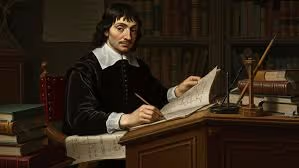
René Descartes was born in La Haye en Touraine (now Descartes) in 1596, educated by the Jesuits at La Flèche, and spent most of his adult life in the Dutch Republic, where the intellectual climate was more tolerant. He is remembered in the humanities for the Meditations and Discourse on Method, and in mathematics for inventing analytic geometry — the fusion of algebra and geometry through coordinate systems that still bears the name Cartesian.
In physics his most consequential move was the 1644 Principia Philosophiae, where he proposed that God had endowed the universe with a fixed quantitas motus — a "quantity of motion" — measured as |m·v|, which would be conserved through all the collisions and motions of the material world. It was the first attempt at a conservation law in modern physics. Descartes was close to right: what he called quantity of motion became, with the addition of direction (the vector sign), Newtonian momentum, which is genuinely conserved.
Huygens caught the error within a generation. Descartes's instinct — that something about motion must be preserved under all interactions — became one of the founding assumptions of classical mechanics. He died in Stockholm in 1650, having reluctantly agreed to tutor Queen Christina of Sweden at five in the morning through a Swedish winter, a regime he blamed for his final illness.
Contributions
- 01proposed the first conservation law in modern physics (quantity of motion, 1644)
- 02invented analytic geometry and Cartesian coordinates
- 03founded modern continental rationalist philosophy
- 04stated an early version of the law of inertia