Pierre Bouguer
Took pendulums up the Andes and measured how gravity changes with altitude.
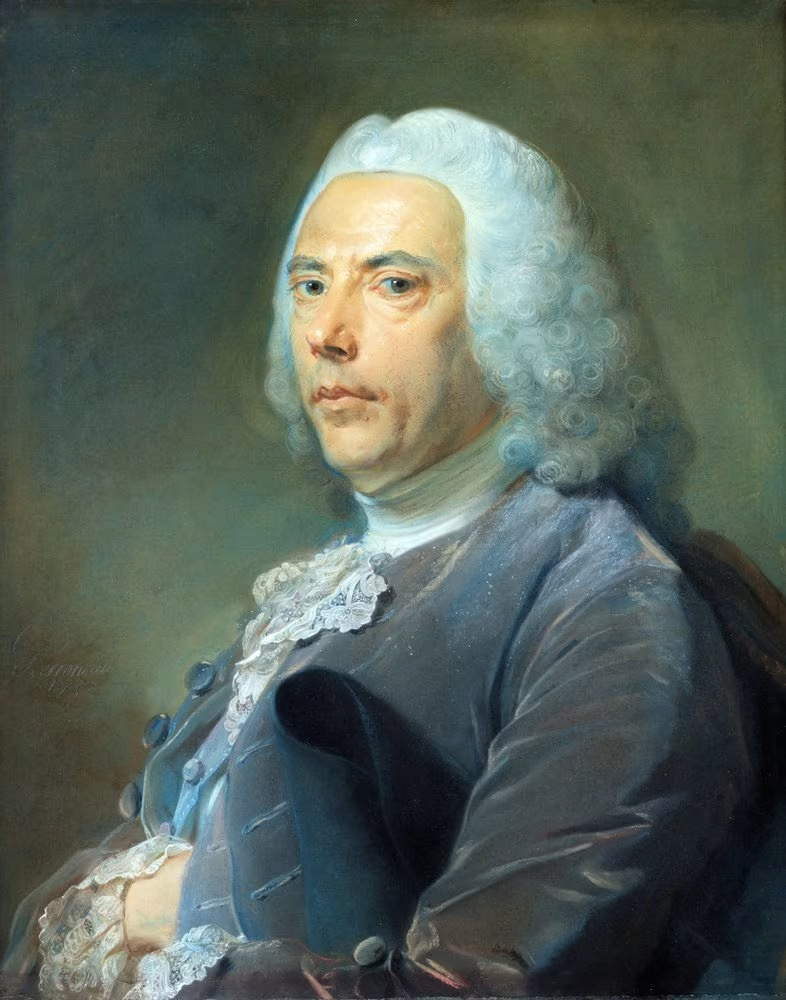
Biography
Pierre Bouguer was born in 1698 in Le Croisic, Brittany, the son of a royal hydrographer. He showed mathematical ability early: when his father died in 1714, the sixteen-year-old was appointed to succeed him as professor of hydrography. He won prizes from the Académie des Sciences for work on ship masting and the observation of stars near the horizon, and was elected to the Académie in 1731.
In 1735 the Académie sent two expeditions to measure the shape of the Earth — one to Lapland, one to the equator. Bouguer joined the equatorial mission to Peru (modern Ecuador), led by Charles Marie de La Condamine. The expedition lasted nearly a decade and was plagued by illness, disputes, and the murder of one member. Despite the difficulties, Bouguer made the first systematic gravity measurements at different altitudes, swinging pendulums at sea level and on the slopes of Chimborazo and Pichincha. He found that gravity decreased with altitude, as expected, but by less than a simple inverse-square law would predict — because the mass of the mountain beneath him was pulling upward. The correction he devised, now called the Bouguer anomaly, remains a standard tool in geophysics and mineral exploration.
Bouguer also founded photometry. His Essai d'optique sur la gradation de la lumière (1729) was the first work to measure the intensity of light quantitatively. He established that light attenuates exponentially as it passes through a transparent medium — the law now known as the Beer-Bouguer law (or Beer-Lambert law). He invented the first photometer and used it to compare the brightness of the Sun and Moon. These measurements made him the first person to put numbers on how bright things are.
Contributions
- 01founded photometry and invented the first photometer (1729)
- 02established the exponential attenuation of light (Beer-Bouguer law)
- 03first systematic gravity measurements at altitude using pendulums
- 04Bouguer anomaly — gravity correction for terrain mass
- 05measured the gravitational attraction of mountains
Major works
The founding work of photometry. Established the exponential law of light absorption in transparent media and introduced methods for comparing the brightness of celestial bodies.
Account of the geodesic expedition to Peru, including Bouguer's gravity measurements at different altitudes, the deflection of a plumb line near mountains, and the first formulation of what is now the Bouguer anomaly.
A comprehensive treatise on naval architecture and ship stability. Introduced the concept of the metacenter — the point that determines whether a ship will right itself or capsize — laying the foundations of naval engineering.