Nicolaus Copernicus
Moved the Earth out of the center of the universe, and kept the circles.
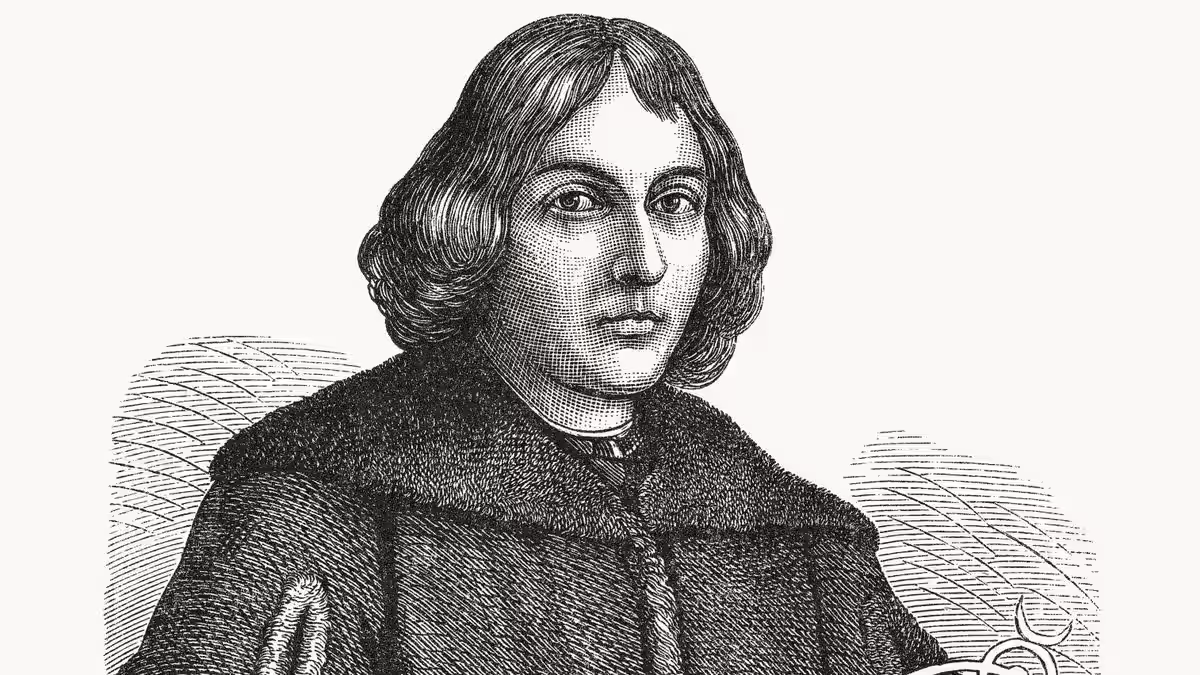
Biography
Nicolaus Copernicus was born in 1473 in the Polish city of Toruń. He trained in canon law, medicine, and mathematics at universities in Kraków, Bologna, and Padua, and spent most of his adult life as a church administrator in the cathedral chapter at Frombork. Astronomy was a private obsession that he worked on for decades before publishing.
His book De revolutionibus orbium coelestium appeared in 1543, the year he died. In it he proposed that the Sun, not the Earth, sits at the center of the universe, with the Earth and the other planets moving around it. The idea was not entirely new — some Greek astronomers had suggested it — but Copernicus was the first to work out a full mathematical model. He kept one ancient assumption that would turn out to be wrong: that the orbits are circles. To match the observed motions, he still needed epicycles, though fewer than Ptolemy.
The heliocentric picture took another century to win out. Galileo's telescope, Kepler's ellipses, and Newton's gravity did the heavy lifting. But the starting point — the move that made the rest possible — was Copernicus's decision to let the Earth be just another planet.
Contributions
- 01heliocentric model of the solar system (De revolutionibus, 1543)
- 02gave the Earth a rotational and orbital motion
- 03reduced the number of epicycles needed to fit observations
- 04estimated the order and relative distances of the planets
- 05inspired Kepler, Galileo, and Newton
Major works
Six-book treatise proposing a heliocentric model of the universe with the Sun at the center and the Earth as a rotating planet in orbit around it. The founding document of the Copernican Revolution.
Short anonymous manuscript circulated privately among a few friends, outlining the heliocentric hypothesis in seven axioms. The earliest written statement of Copernicus's new cosmology.
A treatise on coinage presented to the Prussian Diet at the request of King Sigismund I. Distinguished between the use value and exchange value of commodities, anticipating concepts later developed by Adam Smith.