Léon Foucault
Hung a pendulum in the Panthéon and made the Earth's rotation visible.
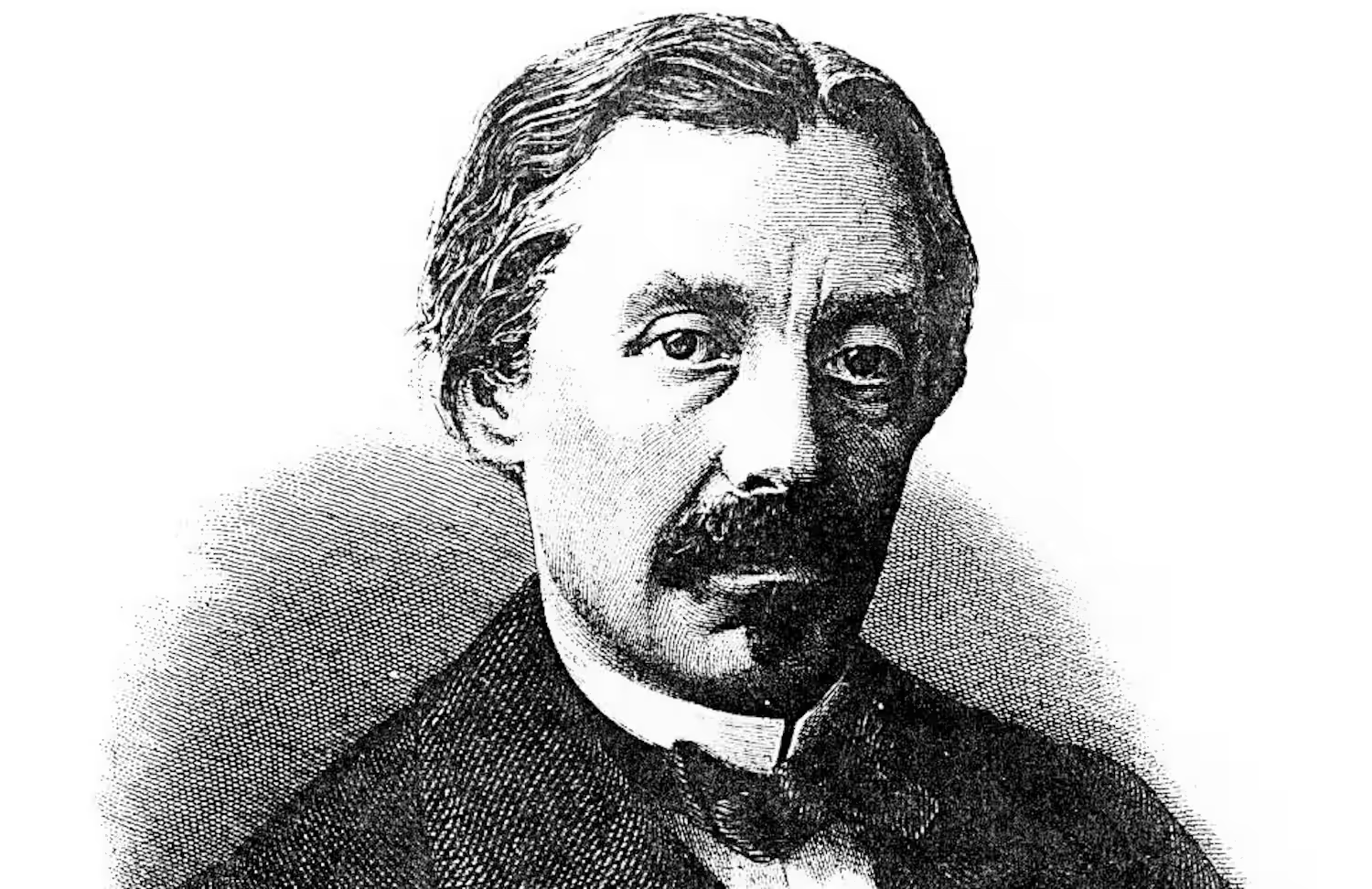
Biography
Léon Foucault was born in Paris in 1819 and trained as a physician before abandoning medicine for experimental physics. He had a gift for building instruments that made invisible things visible. In 1851 he suspended a 28-kilogram brass bob on a 67-metre wire from the dome of the Panthéon in Paris and set it swinging. As the hours passed, the plane of the swing slowly rotated relative to the floor — not because the pendulum was turning, but because the Earth underneath it was. For the first time, anyone who walked in off the street could watch the planet rotate beneath their feet.
The following year Foucault built the first gyroscope and used it to demonstrate the same rotation in a different way. He also invented a method for measuring the speed of light in the laboratory, using a rotating mirror, and showed that light travels more slowly through water than through air — a result that damaged Newton's corpuscular theory and helped restore Huygens's wave picture.
Foucault died in 1868, not yet fifty, from what was probably multiple sclerosis. His pendulum still hangs in museums around the world.
Contributions
- 01Foucault pendulum demonstration of Earth's rotation (1851)
- 02invented the gyroscope (1852)
- 03measured the speed of light with a rotating mirror
- 04showed light travels slower in water than in air
- 05developed the Foucault knife-edge test for telescope mirrors
Major works
Published in Comptes rendus de l'Académie des Sciences. Described the Panthéon pendulum experiment that provided the first simple, direct proof of the Earth's rotation.
Showed that light travels more slowly in water than in air using the rotating-mirror method, delivering a decisive blow to Newton's corpuscular theory of light.
Used an improved rotating-mirror apparatus to measure the speed of light in air at 298 000 km/s, within 0.6% of the modern value, and derived a new estimate of the solar parallax.
Introduced and named the gyroscope, demonstrating Earth's rotation by a conceptually simpler method than the pendulum.