Jules Antoine Lissajous
Pointed light at vibrating mirrors and drew the curves that bear his name.
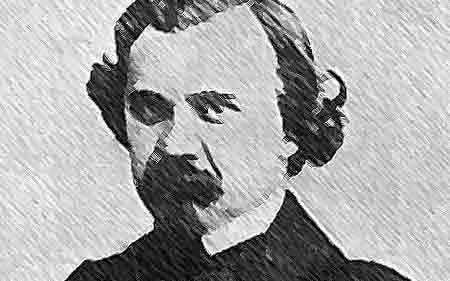
Biography
Jules Antoine Lissajous was born in Versailles in 1822 and studied at the École Normale Supérieure in Paris. He spent his career as a professor of physics in Paris, first at the Lycée Saint-Louis and later at other institutions, working primarily on acoustics and the physics of vibration.
Lissajous's principal contribution was the development of an optical method for studying vibrations. In 1855 he attached small mirrors to the prongs of tuning forks, bounced a beam of light off them, and projected the result onto a screen. When two forks vibrate at right angles, the reflected spot traces out the looping, interlocking curves now called Lissajous figures. The shape of the curve depends on the ratio of the two frequencies and their relative phase: a 1:1 ratio produces an ellipse, 1:2 produces a figure-eight, and more complex ratios produce increasingly intricate but perfectly regular patterns.
The method was more than a visual curiosity. Before electronic instruments existed, Lissajous figures provided the most precise way to compare frequencies. If the two tuning forks are slightly detuned, the figure slowly rotates or deforms, making even small frequency differences visible. This technique was used for decades in acoustics laboratories and instrument calibration. The same mathematics describes any pair of coupled oscillations — two pendulums, two electrical circuits, two modes of a vibrating plate — and Lissajous figures remain a standard diagnostic tool on oscilloscopes.
Lissajous was awarded the Lacaze Prize by the Académie des Sciences in 1873 for his work on the optical observation of vibrations. He died in Plombières-les-Bains in 1880. His figures appear in every physics textbook that covers oscillations, and the mathematics behind them — superposition of sinusoidal motions at right angles — is one of the cleanest illustrations of how simple ingredients produce complex, beautiful patterns.
Contributions
- 01invented optical method for visualising vibrations using mirrors on tuning forks (1855)
- 02Lissajous figures — curves from superposition of perpendicular oscillations
- 03precision frequency comparison technique used before electronic instruments
- 04contributions to experimental acoustics
Major works
Presented to the Académie des Sciences. Described the mirror-and-tuning-fork apparatus for producing Lissajous figures and demonstrated how frequency ratios and phase differences determine the shape of the resulting curves.
Lissajous's doctoral thesis on the transverse vibration of bars. Studied the positions of nodal lines and laid the groundwork for his later optical methods.
First public description of the optical method for observing vibrations. Demonstrated that a beam of light reflected from a vibrating mirror traces the waveform of the vibration on a distant screen.