John Wallis
English mathematician who got momentum conservation right, with the sign, in 1668.
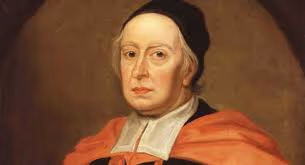
Biography
John Wallis was born in Ashford, Kent, in 1616, took his MA at Emmanuel College, Cambridge, and spent most of his working life as Savilian Professor of Geometry at Oxford. He was a founding member of the Royal Society, a cryptanalyst for Parliament during the English Civil War, and one of the most productive mathematicians of the seventeenth century. He introduced the symbol ∞ for infinity and contributed key ideas to the development of the calculus — his Arithmetica Infinitorum was one of Newton's main sources.
In 1668 the Royal Society posed a public challenge: state the laws that govern collisions between bodies. Three correct replies came in, from Wallis, Huygens, and Christopher Wren. Wallis handled perfectly inelastic collisions (bodies that stick together), Wren the elastic case of equal masses, and Huygens the general elastic case. Wallis's key contribution was to treat velocities as signed quantities — vectors, in essence — and so correct the Cartesian error that had treated them as magnitudes. With the sign, momentum conservation held exactly.
He died in Oxford in 1703, having outlived most of the English mathematicians of his generation and shaped the mathematical climate into which Newton's Principia would arrive.
Contributions
- 01introduced the symbol ∞ for infinity
- 02wrote Arithmetica Infinitorum, one of Newton's main sources for calculus
- 03derived the law of perfectly inelastic collisions, with signed velocities (1668)
- 04founded British cryptography during the Civil War