James Prescott Joule
Proved by paddle wheel that mechanical work and heat are two forms of the same thing.
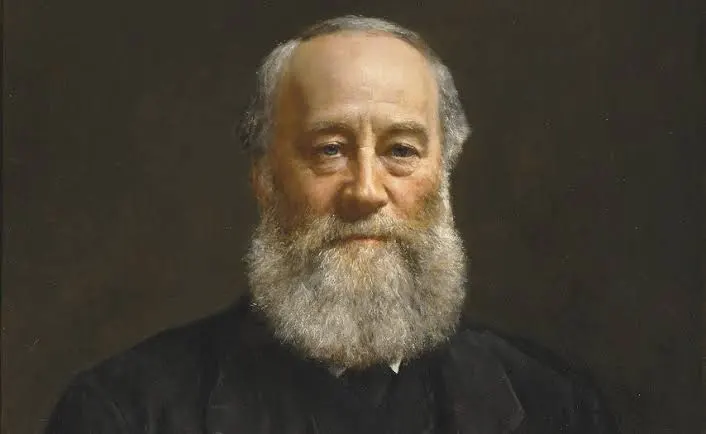
Biography
James Prescott Joule was born in Salford, near Manchester, in 1818, the son of a wealthy brewer. Educated privately — one of his tutors was the chemist John Dalton — he lived off the family business and pursued physics as a private obsession for most of his working life. His early papers in the 1840s were rejected by the Royal Society and dismissed as the work of a provincial amateur.
He is remembered for the paddle-wheel experiments, carried out and refined between 1843 and 1850. The apparatus was simple: a weight on a string drove a shaft that spun a paddle wheel inside an insulated tank of water. The weight fell, the paddle stirred, and the water warmed. Joule measured both the mechanical potential energy given up by the weight and the resulting temperature rise, inferred the heat generated, and showed — over many runs — that the two were exactly proportional. His mechanical equivalent of heat, approximately 4.18 joules per calorie, is one of the foundational constants of thermodynamics. The SI unit of energy, the joule (J), bears his name.
Joule's work was the decisive experimental demonstration that heat is not a fluid (the old caloric theory) but a form of energy convertible from mechanical work. Combined with contemporary insights from Mayer, Helmholtz, and Thomson (Lord Kelvin), it became the first law of thermodynamics: energy is conserved across all its forms, mechanical, thermal, and chemical. Joule collaborated with Kelvin on the Joule–Thomson effect, which is still used in refrigeration and gas liquefaction. He died in Sale in 1889.
Contributions
- 01measured the mechanical equivalent of heat to high precision (1843–1850)
- 02established experimentally that heat is a form of energy
- 03laid groundwork for the first law of thermodynamics
- 04discovered the Joule–Thomson effect (with William Thomson)
- 05studied the heating effect of electric currents (Joule heating)