Jakob Steiner
Swiss geometer whose parallel-axis theorem lets moment of inertia be computed about any axis from the centre-of-mass value.
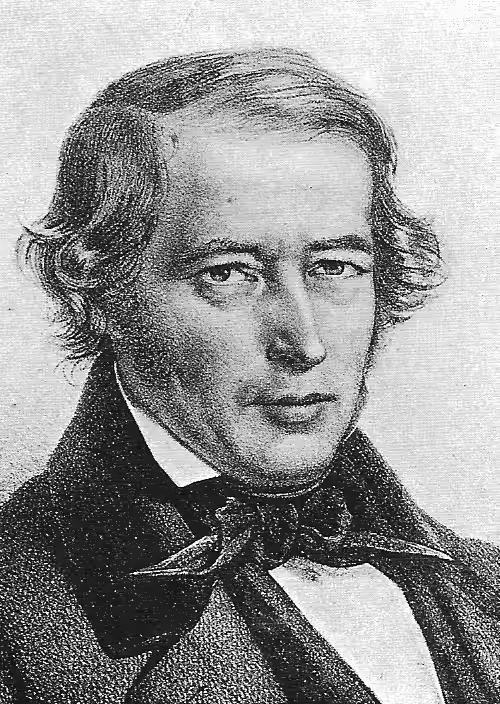
Biography
Jakob Steiner was born in Utzenstorf, Switzerland, in 1796, to a peasant family. He did not begin formal schooling until age 14, but by 19 he was teaching mathematics in Yverdon under Pestalozzi and in 1834 was appointed extraordinary professor of mathematics at the University of Berlin, a position he held until his death. He is remembered as one of the greatest pure geometers of the nineteenth century, working almost exclusively in synthetic projective geometry rather than analytic coordinates.
His name is attached to the parallel-axis theorem in rigid-body mechanics: the moment of inertia of a body about any axis equals the moment of inertia about the parallel axis through its center of mass, plus M·d² for the offset. The theorem is a direct consequence of the definition of the center of mass and is stated in modern engineering textbooks sometimes as Steiner's theorem. He contributed many other results in projective geometry, conic sections, and the theory of surfaces.
He died in Bern in 1863 and left a substantial bequest to Swiss schools for the education of poor children. The Steiner prize, awarded by the Berlin Academy, still bears his name.
Contributions
- 01proved the parallel-axis theorem for moments of inertia (Steiner's theorem)
- 02founded modern synthetic projective geometry
- 03contributed major results on conic sections and ruled surfaces
- 04taught geometry at the University of Berlin for nearly thirty years