Henry Cavendish
Weighed the Earth in his garden shed with a torsion balance and two lead balls.
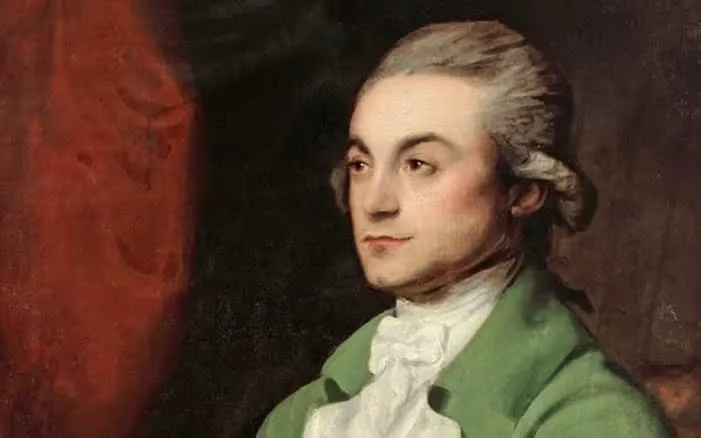
Biography
Henry Cavendish was born into one of England's wealthiest aristocratic families and spent his entire fortune on science. Painfully shy — contemporary accounts describe him as barely able to speak to anyone, especially women — he communicated almost entirely through written notes, even with servants in his own house.
Despite his reclusiveness, Cavendish was one of the most precise experimenters who ever lived. In 1798, at the age of 67, he performed what is now called the Cavendish experiment: using a torsion balance designed by John Michell (who died before completing the work), he measured the tiny gravitational attraction between lead spheres. The apparatus was so sensitive that he had to observe it by telescope through a window to avoid disturbing it with his body heat.
From the measured force, the known masses, and the geometry, Cavendish extracted the density of the Earth — 5.448 times that of water, remarkably close to the modern value of 5.515. This was equivalent to determining the gravitational constant G, though Cavendish himself never expressed it that way. With G and the known value of surface gravity g, Newton's law gives Earth's mass: M = gR²/G. The man who weighed the Earth did it with lead balls, a wire, and extraordinary patience.
Cavendish also independently discovered what we now call Coulomb's law of electrostatics, Ohm's law of resistance, Richter's law of chemical equivalents, and the composition of water — but published almost none of it. His unpublished papers, edited by Maxwell a century later, revealed decades of discoveries that others would eventually rediscover and receive credit for.
Contributions
- 01measured the gravitational constant G (Cavendish experiment, 1798)
- 02determined the density of the Earth to within 1% of the modern value
- 03independently discovered Coulomb's law of electrostatics
- 04determined the composition of water and atmospheric air
- 05pioneered precise electrical measurements decades before Ohm and Faraday
Major works
Published in Philosophical Transactions, this paper described the torsion balance experiment that measured the gravitational attraction between known masses. The result — Earth's mean density is 5.448 times that of water — was the first precise determination of a fundamental constant of nature.