Henri Poincaré
Tried to solve the three-body problem, failed, and discovered chaos instead.
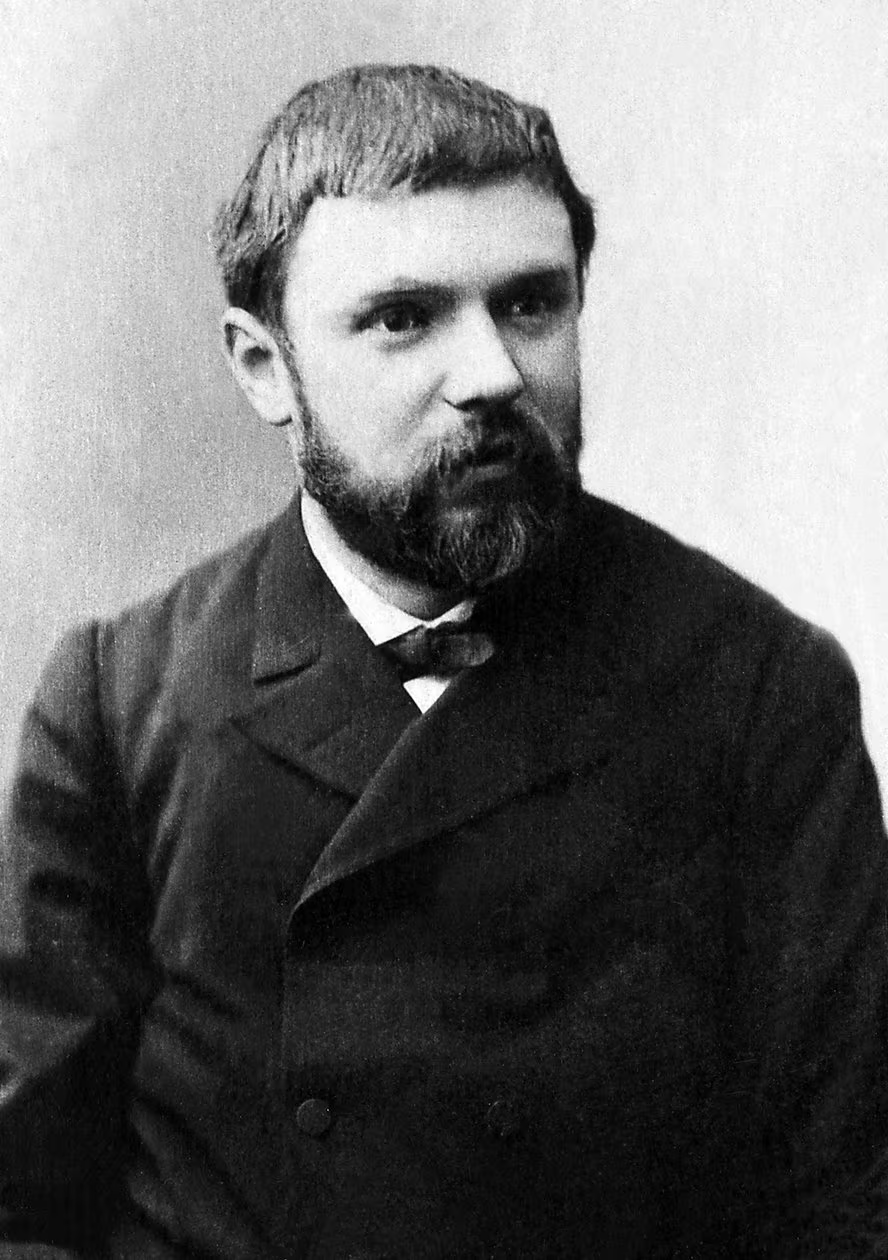
Biography
Jules Henri Poincaré was the last mathematician who could claim mastery of the entire field. He made foundational contributions to topology, complex analysis, celestial mechanics, number theory, and the philosophy of science — often creating entirely new branches of mathematics to solve the problems he encountered.
In 1887, King Oscar II of Sweden offered a prize for a solution to the n-body problem: prove that the solar system is stable. Poincaré submitted a brilliant memoir on the restricted three-body problem. He proved that no general closed-form solution exists, but went further: he showed that certain orbits exhibit what we now call sensitive dependence on initial conditions — infinitesimally close starting points diverge exponentially. This was the birth of chaos theory, though the word would not be coined for another eighty years.
The story has a famous twist: Poincaré's original prize-winning memoir contained an error. When his colleague Lars Edvard Phragmén found it during preparation for publication, Poincaré realised the error was more interesting than the original result. The corrected version — which he paid to have reprinted at a cost exceeding the prize money — contained the first description of homoclinic tangles, the geometric structures that make chaotic systems chaotic.
Poincaré also came within a whisker of special relativity (deriving the Lorentz transformations independently of Einstein), laid the groundwork for algebraic topology, and wrote popular science books that are still read today. He died suddenly in 1912 at the height of his powers.
Contributions
- 01discovered deterministic chaos in the three-body problem (1890)
- 02founded algebraic topology (Analysis Situs, 1895)
- 03independently derived the Lorentz transformations (1905)
- 04proved the non-existence of general solutions to the three-body problem
- 05introduced the concept of homoclinic orbits and their tangles
Major works
Three-volume treatise on celestial mechanics. Introduced qualitative methods for studying differential equations, discovered homoclinic orbits, and laid the mathematical foundations for chaos theory.
The corrected prize memoir for King Oscar II. Demonstrated sensitive dependence on initial conditions in the restricted three-body problem — the first rigorous result in what would become chaos theory.