Guillaume Amontons
Deaf instrument-maker who distilled the chaos of friction into two clean laws.
Biography
Guillaume Amontons was born in Paris in 1663 and lost most of his hearing in his teens from a serious illness. He declined medical treatment that might have restored it — he reasoned that he now had fewer distractions and could concentrate better on his studies. He had no formal university training. What he had was a pair of very good hands, a sharp experimental eye, and a determination to make real physics out of tangible objects.
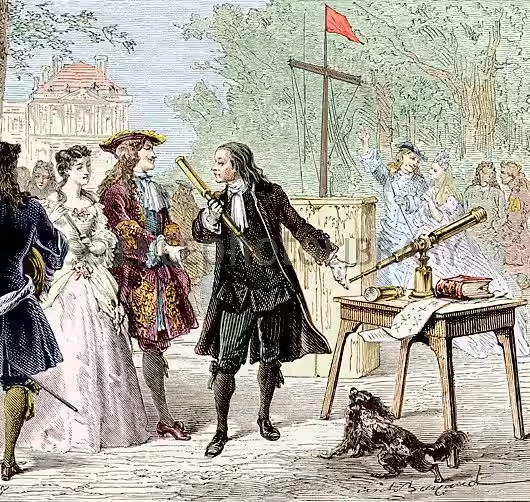
He spent his short life in Paris as a private instrument-maker and a Royal Academy of Sciences correspondent. He designed and built hygrometers, barometers, thermometers, and optical telegraphs. In 1699 he delivered his most famous paper to the Academy — De la résistance causée dans les machines — in which he measured the friction between greased and ungreased surfaces of every combination he could contrive. Out of those measurements he drew two startlingly simple rules: the friction force is proportional to the load pressing the surfaces together, and it is independent of the area of contact.
His laws were not entirely new — Leonardo da Vinci had noted them around 1500, but those notebooks stayed in private hands for centuries. Amontons is the one who published and convinced the rest of European science that friction, messy as it looked, could be captured in two lines of arithmetic. He also designed an air thermometer in 1702 and came within a whisker of noticing absolute zero. He died in 1705 at the age of 42.
Contributions
- 01formulated the classical laws of friction (1699): F ∝ N and F independent of contact area
- 02demonstrated that kinetic friction is roughly independent of sliding speed
- 03designed the air thermometer (1702), anticipating absolute zero
- 04invented an optical telegraph using windmill arms and telescopes
- 05built some of the most accurate barometers and hygrometers of his time
Major works
Memoir to the Royal Academy of Sciences in Paris presenting what are now called Amontons' laws of friction. Reported careful measurements across materials showing that friction depends on load but not on contact area, and laid the experimental foundation for tribology.
An early proposal to use the expansive force of heated air as a source of mechanical work — essentially a design for a hot-air engine, predating practical heat engines by a century.
Description of a constant-volume air thermometer. Amontons observed that the pressure of a fixed volume of air appeared to extrapolate linearly to zero at a particular low temperature — one of the first hints of what would later become absolute zero.