Gottfried Wilhelm Leibniz
Philosopher-mathematician who coined vis viva — the first attempt at what we now call kinetic energy.
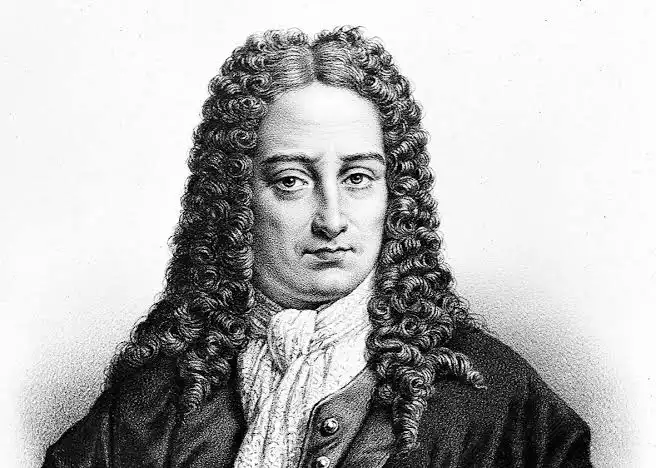
Biography
Gottfried Wilhelm Leibniz was born in Leipzig in 1646 and went on to become one of the most versatile intellects of the seventeenth century. He was a diplomat, a librarian to the Duke of Hanover, a historian, a philosopher, a theologian, a jurist, and — as a private passion — a working mathematician. Between the late 1670s and the mid-1680s he developed an infinitesimal calculus independently of Newton and published it before him. The priority dispute that followed poisoned Anglo-continental mathematics for half a century, but Leibniz's notation — dx, dy, ∫ — is what mathematicians use today.
His 1686 essay Brevis demonstratio erroris memorabilis Cartesii argued against Descartes's definition of the quantity of motion as m·v and proposed instead the scalar m·v² — a quantity Leibniz called vis viva, the "living force". The Cartesians and Leibnizians fought over it for the next sixty years. With modern eyes we can see that both were partially right: m·v (signed — a vector) is conserved in collisions, and so is ½·m·v². Leibniz's vis viva missed a factor of two and didn't become the full law of energy conservation for another two centuries, but the idea that motion-squared was conserved was a decisive step toward it.
Leibniz's influence runs through nearly every branch of rational thought. He anticipated symbolic logic three centuries early; his monadology was one of the first systematic attempts at a metaphysical atomism; his principle of sufficient reason remains a standard move in philosophy. He died in Hanover in 1716, mostly forgotten by his patrons and in debt. His collected works are still being published.
Contributions
- 01co-invented the infinitesimal calculus (independently of Newton)
- 02introduced the modern notation dx, dy, and ∫ for calculus
- 03proposed vis viva (m·v²) as a conserved quantity of motion (1686)
- 04anticipated binary arithmetic and symbolic logic
- 05developed the monadology as a systematic metaphysics