George Gabriel Stokes
Worked out how slow-moving spheres disturb a fluid, and handed physics half of tribology and all of Brownian-motion analysis.
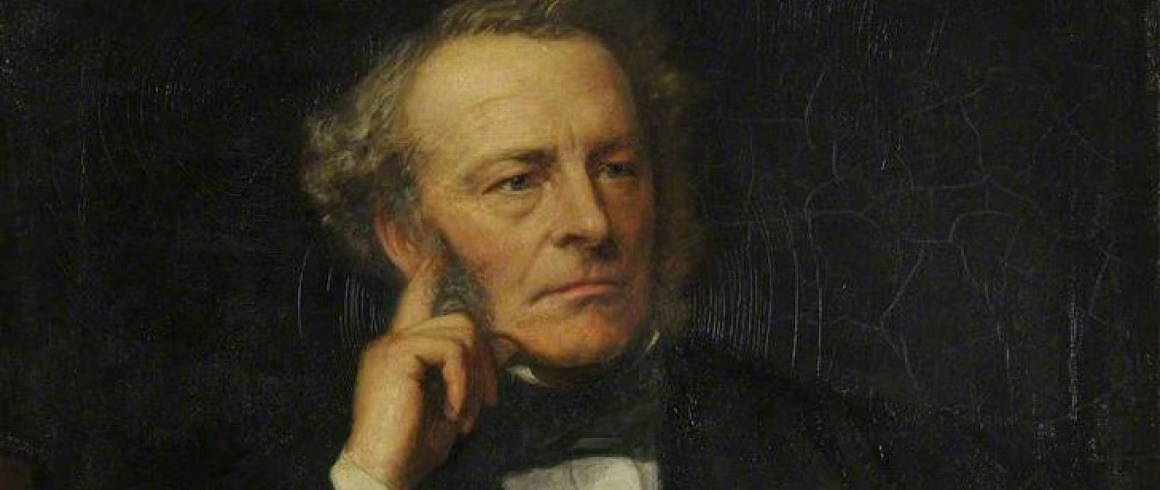
Biography
George Gabriel Stokes was born in Skreen, County Sligo, in 1819, the son of a Church of Ireland rector. He read mathematics at Pembroke College, Cambridge, where he was Senior Wrangler in 1841 — the top-ranked student in the Mathematical Tripos. He spent the rest of his working life in Cambridge: appointed Lucasian Professor of Mathematics in 1849 (the chair Newton had held), and Master of Pembroke from 1902 until his death. He held the Lucasian chair for fifty-four years — the longest tenure in its history.
Stokes worked on almost everything in mathematical physics that moved, flowed, or vibrated. He co-formulated the Navier-Stokes equations governing viscous fluid motion. He proved Stokes' theorem in vector calculus — a foundational result and the mathematical backbone of Maxwell's electromagnetism. He gave the first correct explanation of fluorescence, coining the term. He studied diffraction, polarisation, and the spectroscopic structure of sunlight.
His most-cited result today is Stokes' law of viscous drag, published in 1851: F = 6πηrv for the drag on a sphere at low Reynolds number. It became the key to Millikan's electron-charge measurement, Perrin's determination of Avogadro's number, and every modern calculation of low-Reynolds-number swimming.
Stokes was a devout Anglican, served three terms as a Conservative MP for Cambridge University, was created a baronet in 1889, and served as President of the Royal Society from 1885 to 1890. He died in Cambridge in 1903, aged 83.
Contributions
- 01derived Stokes' law for viscous drag on a sphere (1851)
- 02co-formulated the Navier-Stokes equations of fluid motion
- 03proved Stokes' theorem in vector calculus
- 04explained fluorescence and introduced the term (1852)
- 05first correct analysis of the polarisation of sunlight
- 06studied pendulum motion in resistant media — the original motivation for Stokes' law
- 07contributed foundational work on optics, diffraction, and spectroscopy
Major works
Published derivation of what are now called the Navier-Stokes equations for a Newtonian viscous fluid, starting from molecular considerations and a carefully justified stress tensor.
The paper containing Stokes' law: F = 6πηrv for the drag on a sphere at low Reynolds number. Applied to correct the periods of pendulums swinging in air, and became a century later the cornerstone of low-Reynolds-number hydrodynamics.
Introduced the term fluorescence and gave the first correct physical explanation: incident ultraviolet light is absorbed and re-emitted at longer wavelengths. Contains what is now called Stokes' shift.
A mathematically rigorous treatment of the diffraction of light, incorporating polarisation and transverse-wave character, and clarifying the role of the elastic-ether hypothesis then prevalent.