Felix Klein
Göttingen geometer who co-invited Noether and connected geometry to groups via the Erlangen program.
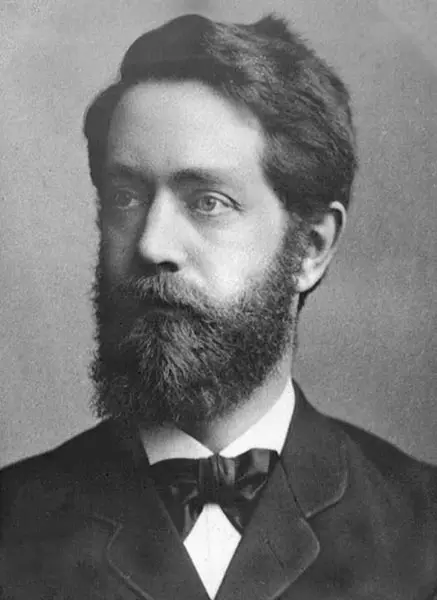
Biography
Felix Klein was born in Düsseldorf in 1849 and spent most of his working life at the University of Göttingen, where he was a dominant administrative figure alongside Hilbert. His 1872 Erlangen Program reorganised geometry around the notion of invariance under groups of transformations: each geometry is characterised by the transformations that leave its defining properties unchanged. This was a deep conceptual rearrangement whose echoes run all through twentieth-century mathematics and physics — including Noether's theorem, which is in effect an Erlangen Program for mechanics.
Klein was also a powerful advocate for improving mathematical education in Germany and for recruiting exceptional talent to Göttingen. Together with Hilbert he invited Emmy Noether to Göttingen in 1915, backed her against the faculty's refusal to appoint her, and helped bring her work on invariance in general relativity to Einstein's attention. He died in 1925, aged 76.
Contributions
- 01formulated the Erlangen Program classifying geometries by their invariance groups (1872)
- 02introduced the Klein bottle and developed the theory of non-orientable surfaces
- 03co-founded modern group theory with Sophus Lie
- 04co-invited Emmy Noether to Göttingen