Amalie Emmy Noether
Proved that every continuous symmetry of a physical system gives a conservation law — the most beautiful theorem in classical physics.
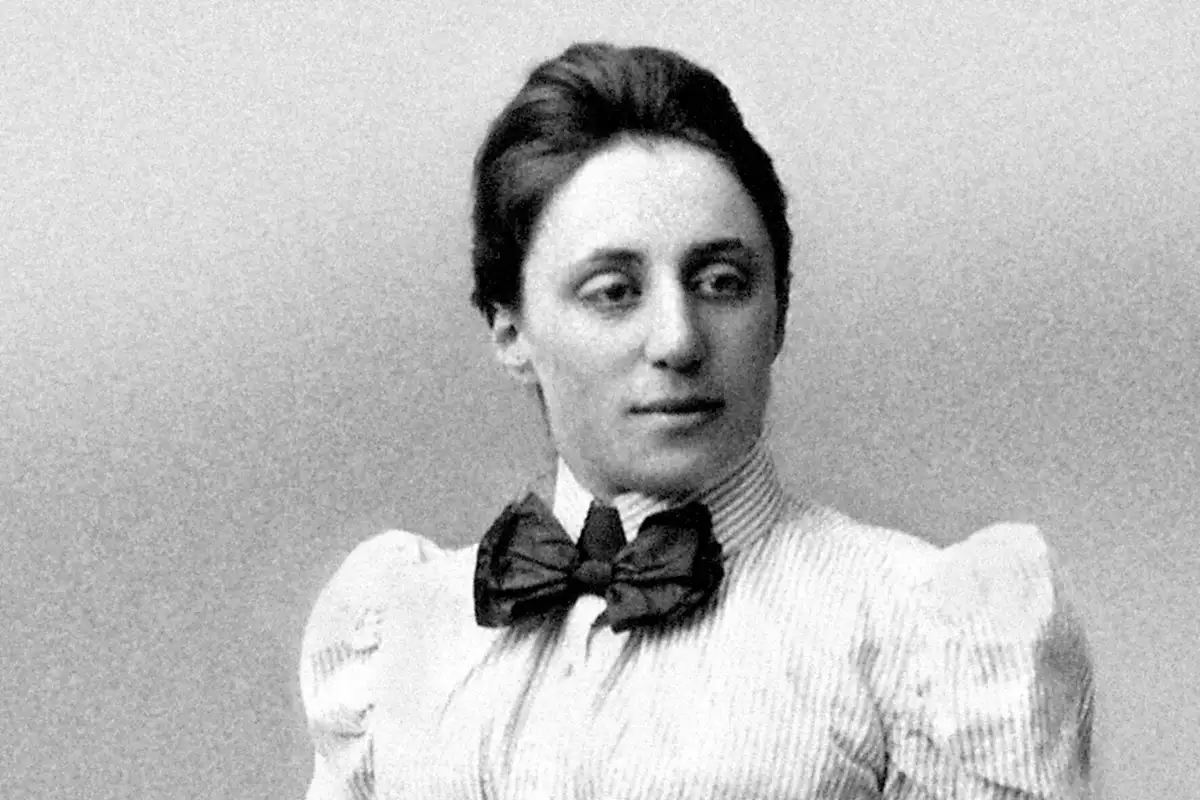
Biography
Emmy Noether was born in Erlangen in 1882, the daughter of the mathematician Max Noether. She wanted to study mathematics at a time when German universities did not admit women, and she audited lectures at Erlangen from 1900 to 1903 — only two women were permitted among nearly a thousand male students. She formally matriculated when rules briefly loosened and took her doctorate in 1907 on invariant theory — work she later dismissed as unremarkable.
From 1908 to 1915 she worked as an unpaid assistant at Erlangen. In 1915 Hilbert and Klein, recognising her exceptional talent, invited her to Göttingen to help with the mathematical formulation of general relativity. The university refused to let her hold a paid teaching position on the grounds of her sex. She lectured under Hilbert's name for years. In 1918 she proved the theorem that bears her name: for every continuous symmetry of a physical system there exists a conserved quantity. Conservation of energy from time-translation symmetry; conservation of momentum from space-translation symmetry; conservation of angular momentum from rotational symmetry. The theorem is the skeleton key to all of modern theoretical physics.
She became a Privatdozent in 1919 and a tenured professor in 1922 — the first woman to hold a full mathematics chair in Germany. She went on to found modern abstract algebra; the structures she introduced (Noetherian rings, Noetherian modules) still bear her name. When the Nazis expelled Jews from German universities in 1933 she emigrated to Bryn Mawr College in the United States. She died there in 1935, aged 53, from complications following surgery. Einstein, unsparing of praise only when he meant it, called her "the most significant creative mathematical genius thus far produced since the higher education of women began".
Contributions
- 01proved Noether's theorem linking continuous symmetries to conservation laws (1918)
- 02founded modern abstract algebra and the theory of Noetherian rings
- 03contributed the mathematical framework for conservation laws in general relativity
- 04supervised a generation of algebraists who carried her program through the 1930s