Gabrielle Émilie Le Tonnelier de Breteuil, Marquise du Châtelet
Translated Newton into French and made the decisive experimental case for vis viva as m·v².
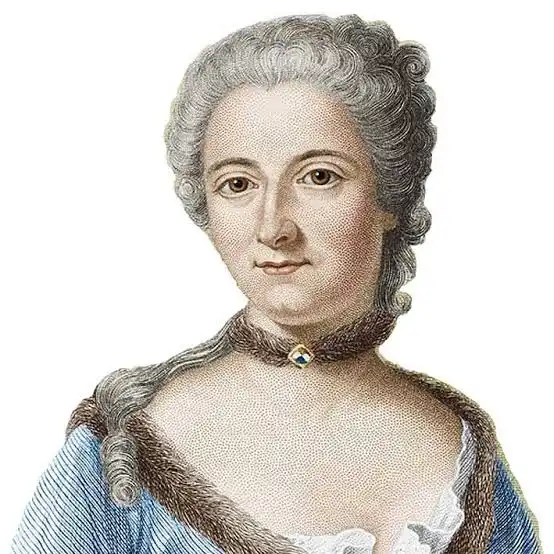
Biography
Émilie du Châtelet was born in Paris in 1706 into minor aristocracy and educated, unusually for a girl of her class, in Latin, Greek, mathematics, and the natural sciences. She married the Marquis du Châtelet at 19 and shortly afterwards entered into a famous partnership with Voltaire, with whom she lived and collaborated for fifteen years at the Château de Cirey in Lorraine, building what was effectively a private research institute.
Her most enduring work was the first — and for two centuries the only — French translation of Newton's Principia. Published posthumously in 1759, it included her own extensive commentary and corrections, bringing Newtonian mechanics to the French-speaking world at a moment when Cartesian physics still dominated the French academy.
Her sharpest scientific contribution came earlier, in the dispute over vis viva between the Newtonians (who held the "quantity of motion" was m·v) and the Leibnizians (who insisted it was m·v²). She read the German experimentalist Willem 's Gravesande's 1722 results — brass balls dropped from varying heights into clay, leaving craters whose volume varied as the square of the impact velocity — and recognised that they settled the argument decisively in Leibniz's favour. Her 1740 Institutions de Physique made this case rigorously to a French audience and established the energy-side intuition that would mature into the conservation of energy in the nineteenth century. She died in 1749 in childbirth, six days after completing her Newton translation.
Contributions
- 01produced the first French translation of Newton's Principia (1759, posthumous)
- 02established, via 's Gravesande's experiments, that kinetic energy scales as m·v²
- 03wrote Institutions de Physique (1740), a major synthesis of Newtonian and Leibnizian thought
- 04co-authored Voltaire's Elements of the Philosophy of Newton