Claudius Ptolemy
Put the Earth at the center of the universe and got away with it for fifteen centuries.
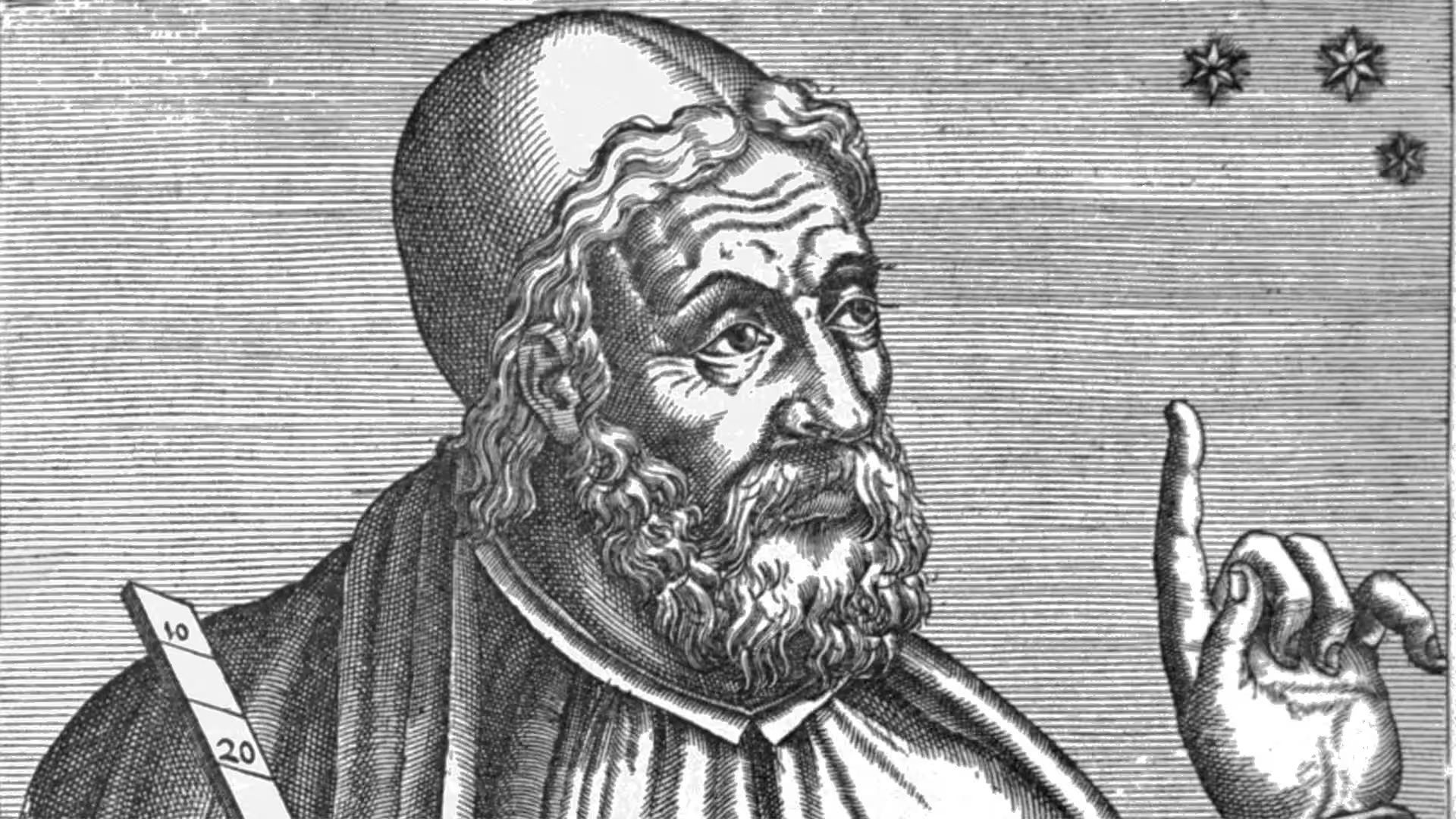
Biography
Claudius Ptolemy lived in Alexandria in the second century of the common era, under Roman rule. Almost nothing is known about his life. What survives is his work — above all the Almagest, a thirteen-book treatise on astronomy that systematized everything the Greek world knew about the heavens and added a great deal of his own measurement and calculation.
The Almagest set out a geocentric cosmos in which the Earth sits motionless at the center and the Sun, Moon, and planets move around it on combinations of circles — deferents and epicycles — tuned to match the observed motions as precisely as possible. The scheme was mathematically ingenious. It predicted planetary positions well enough to remain the standard reference for astronomers in the Islamic world and medieval Europe for more than fourteen hundred years. Copernicus knew the Almagest intimately; so did Kepler and Galileo.
Ptolemy also wrote a Geography that shaped European maps through the Renaissance, and an astrological textbook, the Tetrabiblos, that was still being reprinted in the nineteenth century. His model of the universe was wrong, but it was the wrong model that taught Europe how to calculate.
Contributions
- 01wrote the Almagest, the dominant astronomy text for 1500 years
- 02geocentric model with deferents and epicycles
- 03catalogued over 1000 stars
- 04Geography and early world maps with latitude and longitude
- 05Tetrabiblos, the standard treatise on astrology
Major works
Thirteen-book treatise on astronomy that presented a geocentric model of the universe using deferents and epicycles. Catalogued over 1,000 stars and remained the authoritative astronomical reference for more than 1,400 years.
A gazetteer, atlas, and treatise on cartography compiling the geographic knowledge of the Greco-Roman world. Introduced a coordinate system of latitude and longitude and shaped European mapmaking through the Renaissance.
Four-book treatise on astrology that attempted to place horoscopic practice on an Aristotelian natural-philosophical foundation. Remained the standard astrological text in Europe and the Islamic world for centuries.
Went beyond the mathematical models of the Almagest to present a physical realization of the cosmos as a set of nested spheres, estimating the dimensions of the planetary system.
Treatise on geometrical optics covering reflection, refraction, and colour. Contains the earliest surviving table of refraction from air to water and influenced Ibn al-Haytham's later Book of Optics.