Archimedes of Syracuse
Ancient mathematician and engineer who wrote the first rigorous treatise on levers and equilibrium.
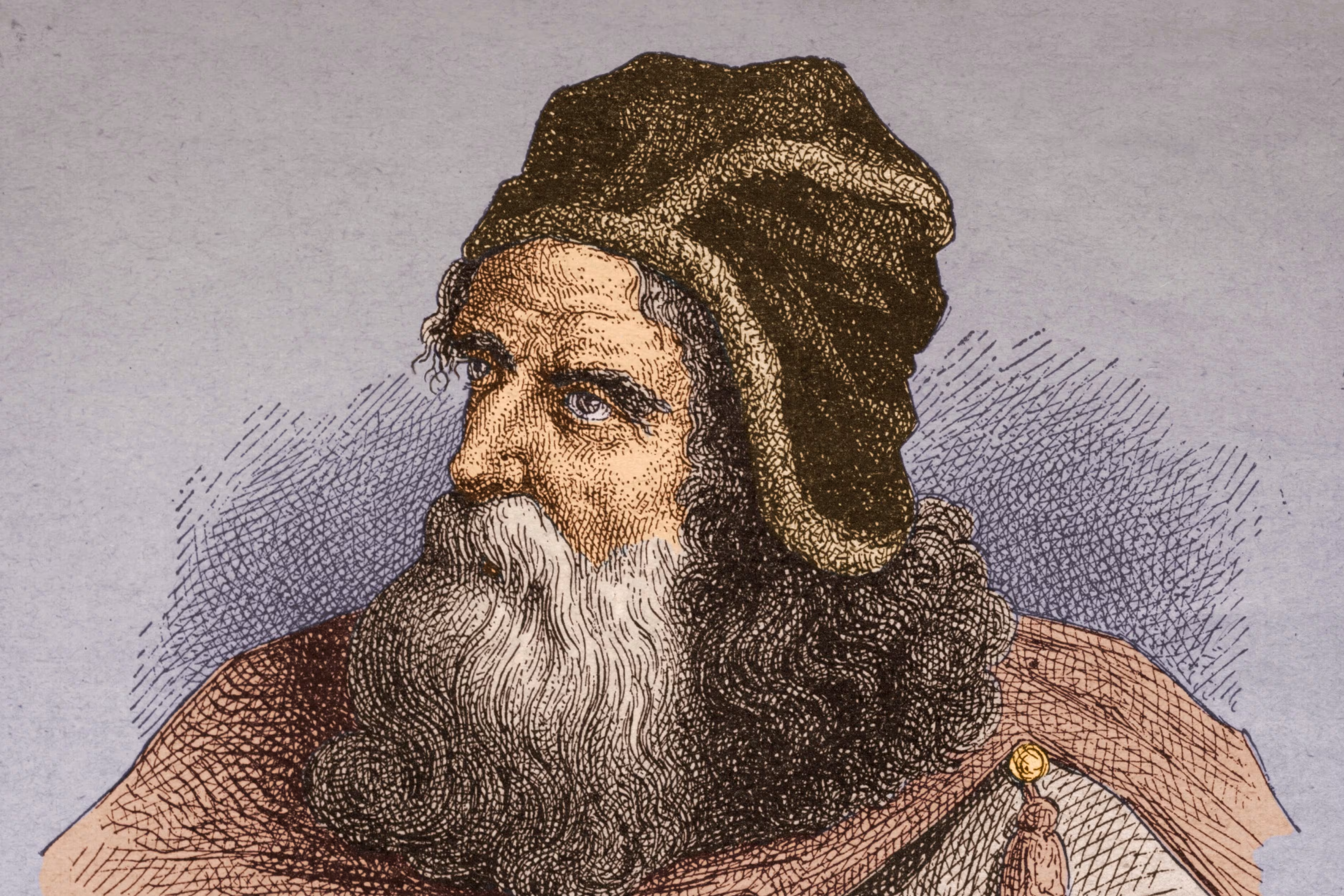
Biography
Archimedes was born in Syracuse, Sicily, around 287 BCE, and lived most of his life in that city. He is one of a small handful of ancient figures whose mathematical work survives in enough volume to judge him genuinely first-rank: his treatises on the sphere and cylinder, on circles, on spirals, on floating bodies, and on the equilibrium of planes are, by the standards of the time, extraordinary.
His On the Equilibrium of Planes, probably written around 250 BCE, gives the first rigorous proof of the law of the lever — that two unequal weights on opposite sides of a fulcrum balance when their distances from the fulcrum are inversely proportional to their weights. He also introduced the concept of the center of gravity and computed it for a range of geometric shapes, laying the foundation for what would become mass and moment analysis in mechanics.
He is equally famous for his engineering: the Archimedean screw for lifting water, compound pulleys that could let one man haul a warship (famously demonstrated for King Hiero II), burning-mirrors that could set enemy ships alight at a distance, and various artillery. He was killed in 212 BCE when Roman forces sacked Syracuse, reportedly while absorbed in a mathematical diagram.
Contributions
- 01proved the law of the lever rigorously (On the Equilibrium of Planes)
- 02introduced the concept of center of gravity
- 03derived the area and circumference of circles, and the surface area and volume of the sphere
- 04developed the method of exhaustion — an ancient precursor of integral calculus
- 05discovered the principle of buoyancy (Archimedes' principle)