Albert Einstein
Redefined space, time, and gravity — and relied on Emmy Noether to sort out energy conservation in general relativity.
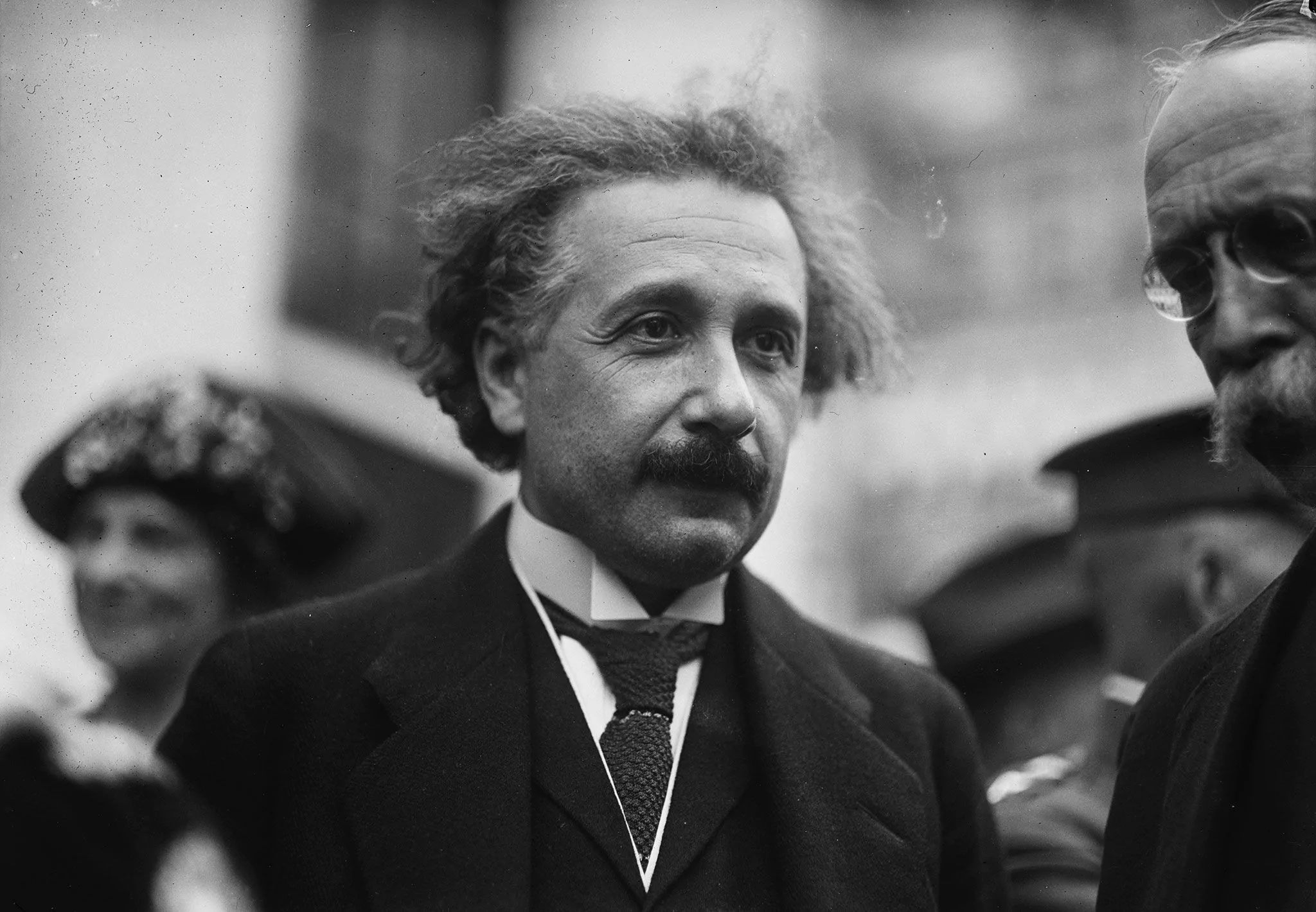
Biography
Albert Einstein was born in Ulm in 1879. After early struggles with German schooling he took a degree at the ETH in Zurich, worked as a patent examiner in Bern, and in 1905 — his miraculous year — published four papers that independently founded special relativity, introduced the photon, proved the reality of atoms via Brownian motion, and derived E = m·c². In 1915, after a decade of work, he completed general relativity, which recast gravity as the curvature of spacetime. He was awarded the Nobel Prize in Physics in 1921, for the photoelectric effect.
During the development of general relativity he consulted Emmy Noether on a subtle technical question: how to make sense of energy conservation in a theory with local gauge invariance. Her solution became part of the mathematical foundation of the theory; she referred to the result as Noether's second theorem, less famous than the first but equally essential for gauge theories. Einstein emigrated to the United States in 1933 when the Nazis came to power and spent the rest of his career at the Institute for Advanced Study in Princeton. He died in 1955.
Contributions
- 01founded special relativity (1905)
- 02derived E = m·c²
- 03published the general theory of relativity (1915)
- 04explained the photoelectric effect, laying groundwork for quantum theory
- 05used Noether's second theorem to clarify energy conservation in general relativity