Adrien-Marie Legendre
Classified the integrals that no one could solve and gave them his name.
Biography
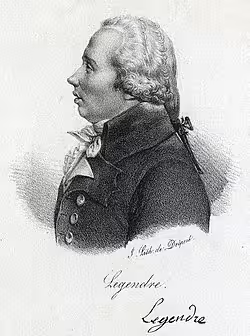
Adrien-Marie Legendre was born in Paris in 1752 into a wealthy family and studied at the Collège Mazarin, where he was taught by the abbé Joseph-François Marie. He showed early talent in mathematics and physics, and by his mid-twenties was teaching at the École Militaire.
Legendre's most lasting contribution is his systematic study of elliptic integrals — the integrals that arise whenever you try to compute the arc length of an ellipse, the exact period of a pendulum at finite amplitude, or the motion of a body under a central force that is not exactly inverse-square. These integrals cannot be expressed in terms of elementary functions, and before Legendre no one had organised them. Over forty years he classified them into three canonical forms (now called elliptic integrals of the first, second, and third kind), computed extensive numerical tables, and developed reduction formulas that let any elliptic integral be expressed in terms of the canonical three. His three-volume Traité des fonctions elliptiques (1825-1828) was the definitive reference until Abel and Jacobi inverted the problem and created the theory of elliptic functions.
Legendre also introduced the Legendre polynomials — solutions to Laplace's equation in spherical coordinates — which are indispensable in electrostatics, gravitational theory, and quantum mechanics. He made foundational contributions to number theory, including the law of quadratic reciprocity (which he conjectured and partially proved before Gauss gave the first complete proof). In 1805 he published the first clear statement of the method of least squares for fitting data, a technique that remains the backbone of experimental science and statistics.
He lost his fortune in the French Revolution and his pension under the Restoration, but continued working into his late seventies. He died in Paris in 1833, largely eclipsed by younger rivals but having built the tools they all used.
Contributions
- 01classified elliptic integrals into three canonical forms
- 02introduced Legendre polynomials for spherical problems
- 03first published the method of least squares (1805)
- 04contributions to number theory and quadratic reciprocity
- 05extensive numerical tables of elliptic integrals
Major works
Three-volume treatise that systematically classified elliptic integrals into three canonical forms and provided reduction formulas and numerical tables. The definitive reference on the subject until the work of Abel and Jacobi.
The first textbook devoted entirely to number theory. Stated the law of quadratic reciprocity, introduced the Legendre symbol, and conjectured the prime number theorem.
Contained the first published account of the method of least squares, applied to the problem of fitting orbital data. The technique became fundamental to all experimental science.
Three volumes developing the theory of elliptic integrals and Euler integrals (beta and gamma functions). Introduced much of the notation and classification still used today.